

Hantavirus Prevention and Rodent Identification
Hantavirus prevention starts with rodent identification and safe cleanup. Deer mice and related rodents can shed Sin Nombre virus in urine, droppings, and nesting material, so property owners need clear ID cues and evidence-based exclusion steps before disturbance.
Introduction

Deer mice are the rodent most commonly associated with Sin Nombre virus, the hantavirus responsible for most hantavirus pulmonary syndrome cases in the United States.
Hantavirus is a serious rodent-borne disease that sits at the intersection of structural pest management and public health. Unlike many pest-related diseases spread by biting arthropods, hantavirus most commonly spreads when people inhale airborne particles contaminated with rodent urine, droppings, saliva, or nesting materials.
For homeowners, the most important questions are practical: which rodents matter most, where exposure is likely, how contaminated areas should be cleaned, and when professional help is appropriate.
Part of the Pest Sherpa Pest Lab series covering pest biology, disease ecology, and evidence-based prevention.
Medical Disclaimer
This article is based on research from public health literature, pest management resources, governmental health agencies, and university extension publications. It is intended for educational and informational purposes only and does not constitute medical advice, diagnosis, or treatment. Hantavirus and other rodent-borne illnesses may present with symptoms requiring professional medical evaluation. Anyone experiencing symptoms associated with hantavirus should seek guidance from a qualified healthcare professional.
TL;DR
Hantavirus is uncommon, but it can cause severe respiratory illness. In North America, deer mice are the rodent most commonly associated with hantavirus pulmonary syndrome. Most infections occur when contaminated rodent waste or nesting material becomes airborne and is inhaled.
Key Takeaways
- Deer mice are the primary reservoir for Sin Nombre virus in much of North America.
- Exposure risk increases when rodent-contaminated dust is disturbed in cabins, sheds, barns, garages, attics, crawl spaces, and storage areas.
- Never sweep or vacuum dry rodent droppings.
- Ventilate, wet contaminated material with disinfectant, remove waste carefully, and wash up afterward.
- Prevention depends on exclusion, sanitation, habitat reduction, trapping, and safe cleanup.
How Serious Is the Risk?
Hantavirus infections remain relatively uncommon in the United States, but hantavirus pulmonary syndrome can become severe and potentially life-threatening. Prevention matters because exposure can occur during ordinary activities such as cleaning a shed, opening a seasonal cabin, moving stored boxes, or disturbing rodent nesting material.
Most confirmed U.S. cases have historically occurred in western states where deer mice are common. However, rodent infestations should be addressed regardless of location because rodents contaminate food, insulation, stored materials, and living spaces.
Jump To
- What Is Hantavirus?
- Why It Matters
- Regional Risk in the United States
- Signs of Rodent Contamination
- How Hantavirus Spreads
- Rodent Reservoirs and Identification
- Symptoms and HPS
- Prevention and Safe Cleanup
- Common Myths
- Authoritative Resources
What Is Hantavirus?
Hantaviruses are a group of viruses naturally maintained by certain rodent species. Humans are accidental hosts and typically become infected through exposure to contaminated rodent urine, droppings, saliva, or nesting materials.
In the United States, the virus most commonly associated with hantavirus pulmonary syndrome is Sin Nombre virus, which is primarily carried by deer mice.
Unlike many pest-associated diseases, hantavirus is not usually spread because rodents bite people. Most exposure occurs when contaminated particles become airborne and are inhaled.
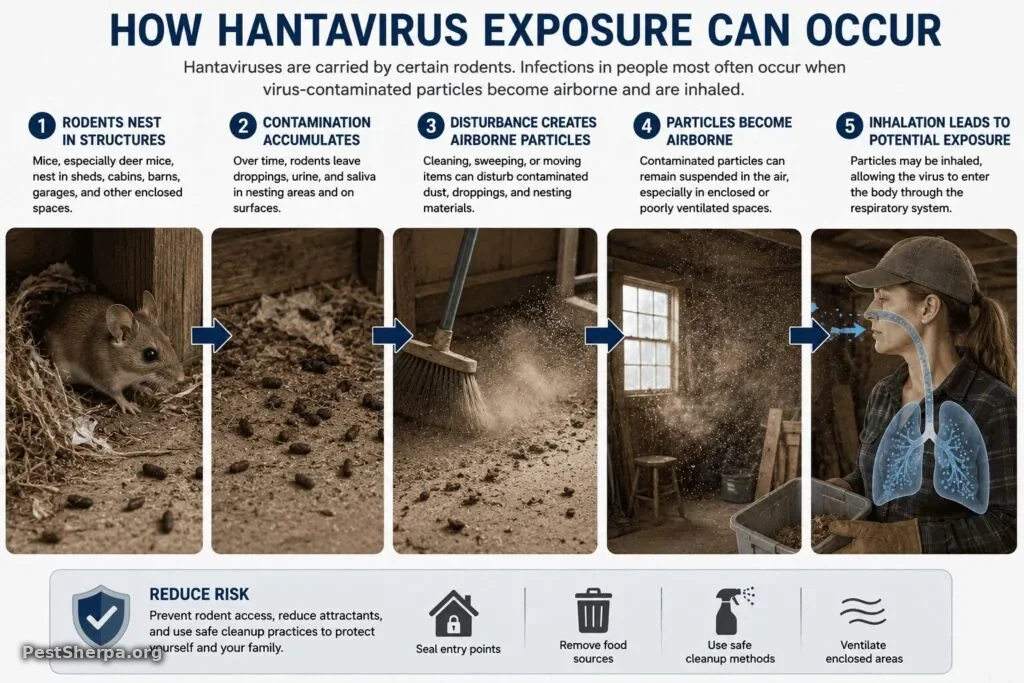
Hantavirus exposure is most often associated with contaminated rodent materials becoming airborne and being inhaled.
Why It Matters
Most rodent infestations create nuisance, sanitation, and property-damage issues. Hantavirus elevates rodent activity into a public-health concern when contaminated droppings, urine, saliva, or nesting materials are present.
Risk is often greatest in:
- Vacant cabins
- Storage buildings
- Barns
- Sheds
- Garages
- Attics
- Crawl spaces
- Seasonal properties
- Structures with long-term rodent activity
Regional Risk in the United States
Hantavirus risk is not distributed evenly across North America. Most confirmed hantavirus pulmonary syndrome cases in the United States have historically occurred west of the Mississippi River, particularly in areas where deer mouse populations are abundant.
That does not mean rodent activity is harmless elsewhere. House mice, rats, deer mice, and other rodents can contaminate structures, damage materials, and create sanitation problems. The presence of rodent activity indoors should be corrected regardless of region.
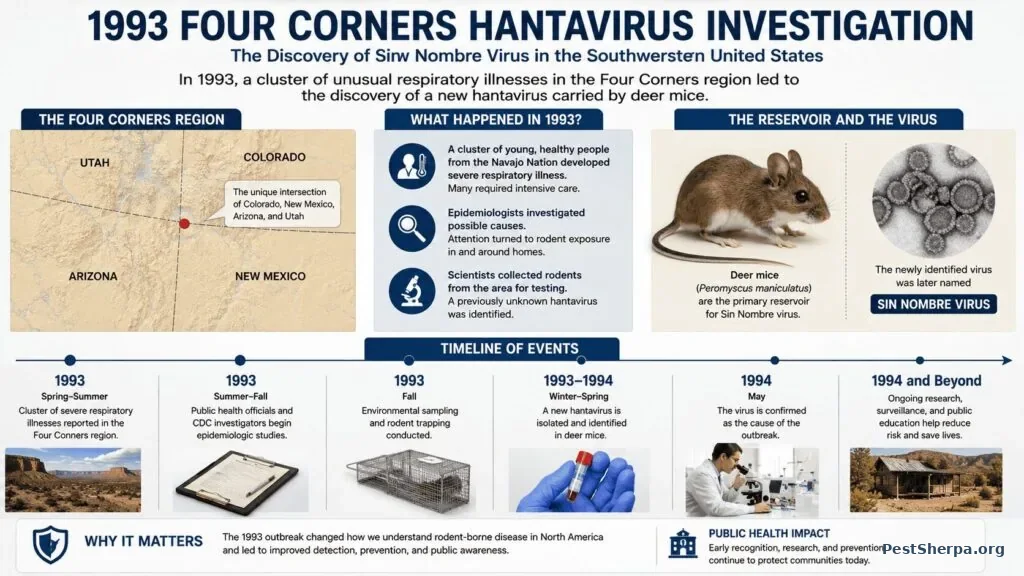
The 1993 Four Corners investigation transformed scientific understanding of rodent-borne disease ecology in North America.
Signs of Rodent Contamination
Many homeowners discover evidence of rodents before they see the animals themselves. Treat enclosed areas cautiously when multiple signs of rodent activity are present.
- Rodent droppings
- Urine odors or staining
- Shredded paper, fabric, insulation, or plant material
- Gnaw marks on wood, wiring, stored goods, or food packaging
- Greasy rub marks along walls, beams, or travel routes
- Noises inside walls, ceilings, attics, or crawl spaces
- Chewed pet food, bird seed, grass seed, or stored pantry items
Do not dry sweep or vacuum these materials. Assess the area first, ventilate when appropriate, and use wet-cleaning methods before disturbing droppings or nesting material.
How Hantavirus Spreads
The most common route of transmission is inhalation of airborne particles contaminated by infected rodents.
Potential exposure sources include:
- Rodent urine
- Rodent droppings
- Rodent saliva
- Nesting materials
- Dust contaminated by rodent activity
Activities that may increase risk include sweeping rodent droppings, vacuuming contaminated areas, cleaning cabins after seasonal closure, disturbing rodent nests, and entering heavily infested enclosed spaces.
Why Rodents Carry Hantaviruses
Reservoir rodents generally do not appear severely ill from the hantaviruses they carry. This allows the virus to persist naturally in rodent populations and be shed through urine, droppings, and saliva.
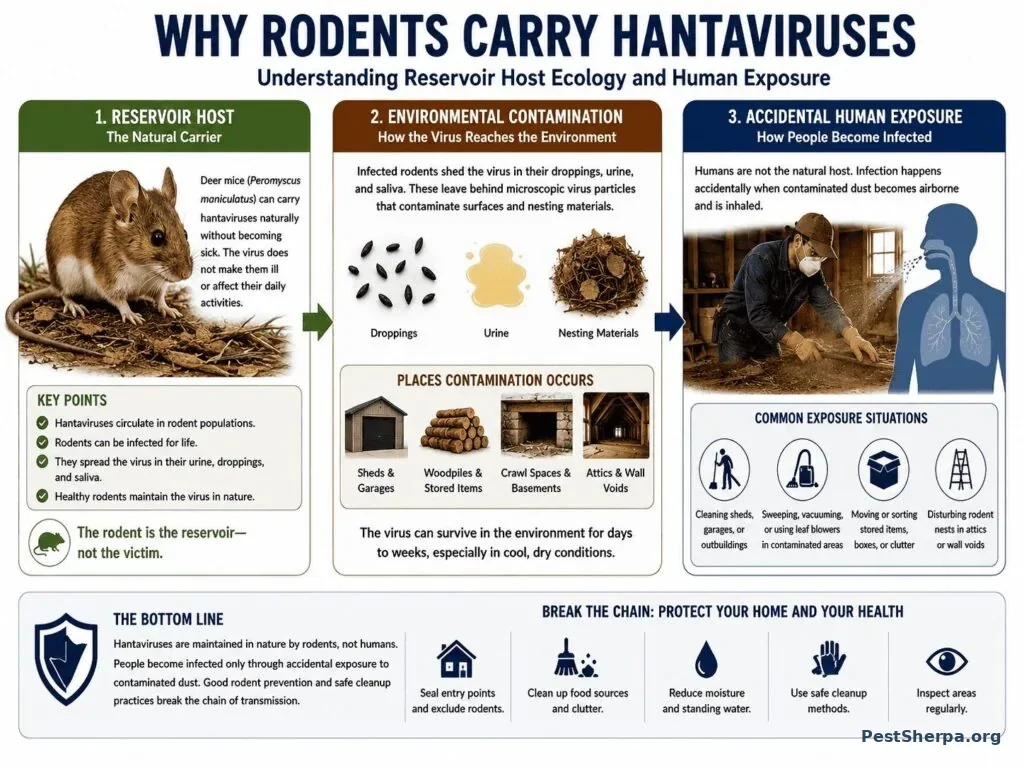
Rodents are reservoir hosts; humans are accidental hosts exposed through contaminated environments.
Rodent Reservoirs and Identification
Not all rodents are equally important in hantavirus discussions. Correct identification helps homeowners understand risk more accurately and avoid assuming every mouse or rat problem carries the same concern.
Deer mice typically have larger eyes and ears, white feet, a white belly, and a sharply bicolored tail. House mice generally lack these features.
| Feature | Deer Mouse | House Mouse | White-Footed Mouse |
|---|---|---|---|
| Belly | White | Gray or gray-brown | White or pale |
| Feet | White | Usually darker | White |
| Eyes | Large | Smaller | Large |
| Ears | Large | Smaller | Large |
| Tail | Sharply bicolored | More uniform | May appear bicolored |
| Common confusion | Often confused with white-footed mouse | Often confused with young deer mice | Often confused with deer mouse |
Deer Mouse
The deer mouse is the primary reservoir for Sin Nombre virus in the United States.
- White belly
- White feet
- Large ears
- Large eyes
- Distinctly bicolored tail
- Brown or gray upper body
White-Footed Mouse
White-footed mice closely resemble deer mice and can be difficult for homeowners to distinguish without close examination. Because the differences can be subtle, homeowners should avoid assuming a rodent is harmless based on appearance alone.
House Mouse
House mice are common structural pests. They contaminate food, insulation, and stored materials, but they generally lack the white belly, white feet, large eyes, and sharply bicolored tail associated with deer mice.
Norway Rat
Norway rats are larger, heavier rodents associated with basements, foundations, sewers, and burrows. They are important public-health pests, but they are generally discussed more often in relation to contamination concerns and other rodent-borne diseases than to hantavirus pulmonary syndrome.
Symptoms and Hantavirus Pulmonary Syndrome
Symptoms often develop between one and eight weeks after exposure. Early symptoms can resemble flu-like illness, so possible rodent exposure should be mentioned to a healthcare provider.
Early Symptoms
- Fever
- Fatigue
- Muscle aches
- Headache
- Chills
- Nausea
- Vomiting
- Dizziness
Later Symptoms
- Shortness of breath
- Coughing
- Chest tightness
- Fluid accumulation in the lungs
- Respiratory distress
Anyone experiencing symptoms following potential rodent exposure should seek medical attention immediately.
Prevention and Safe Cleanup
Prevention focuses on reducing rodent access, reducing attractants, safely removing rodents, and cleaning contaminated areas correctly.
Public health agencies recommend avoiding sweeping or vacuuming dry rodent droppings because doing so can stir contaminated dust into the air.
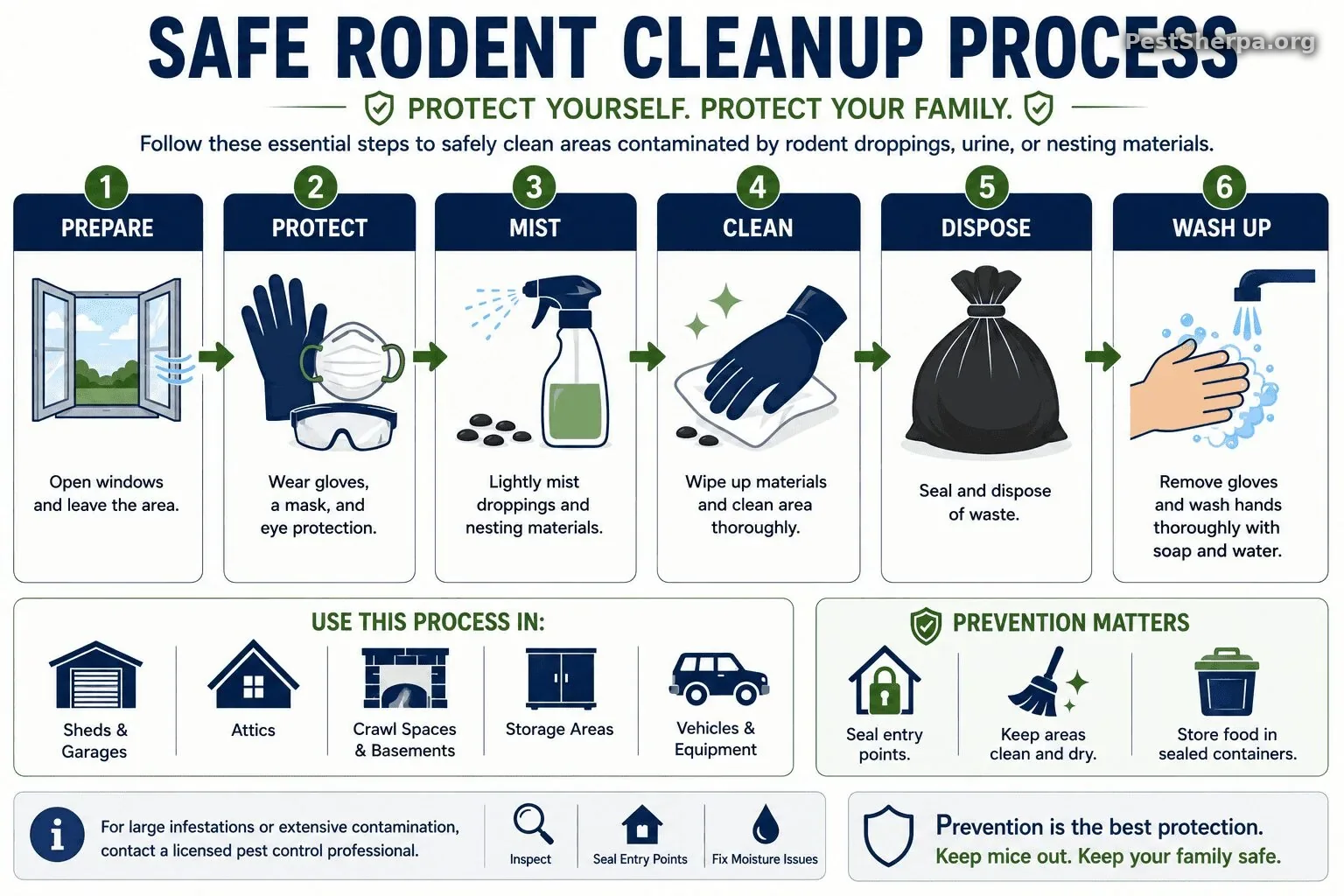
Safe cleanup relies on reducing dust, using protection, wetting contaminated material, removing waste safely, and washing up afterward.
Safe Cleanup Procedure
- Ventilate enclosed spaces before beginning cleanup. Open doors and windows when possible.
- Leave the area during ventilation when practical.
- Wear disposable gloves.
- Do not sweep, vacuum, dust, or use a leaf blower on dry droppings or nesting materials.
- Spray droppings, urine, dead rodents, and nesting materials with disinfectant until thoroughly wet.
- Allow disinfectant to remain according to label directions.
- Remove waste using disposable towels.
- Place contaminated materials into sealed bags.
- Disinfect surrounding surfaces.
- Wash hands thoroughly after removing gloves.
Large accumulations of droppings, contamination in insulation, or contamination in crawl spaces and attics may require professional remediation.
Prevent Rodent Access
Rodent prevention starts with exclusion. Seal openings that allow rodents to enter and move through structures.
- Foundations
- Utility penetrations
- Door sweeps
- Rooflines
- Crawl spaces
- Garage doors
- Vents
- Pipe and wire penetrations
- Attic access points
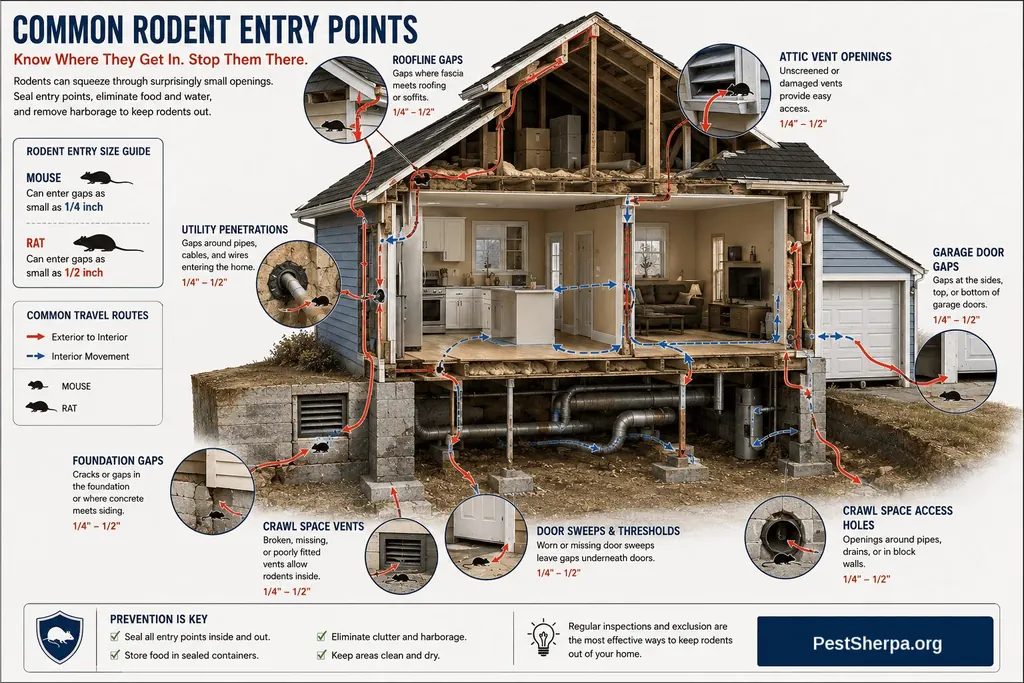
Exclusion is one of the most effective rodent prevention strategies because it addresses how rodents enter and move through structures.
Reduce Attractants
- Store food in sealed containers.
- Keep trash sealed.
- Store pet food and bird seed securely.
- Reduce indoor and outdoor clutter.
- Remove nesting materials.
- Move firewood, brush, and debris away from structures.
- Improve sanitation.
- Reduce moisture where possible.
When Professional Help Makes Sense
Professional help is appropriate when:
- Rodent activity is extensive.
- Large accumulations of droppings are present.
- Attic or crawl-space contamination exists.
- Wall-void contamination is suspected.
- Insulation is contaminated.
- Rodents continue returning after control efforts.
- Entry points cannot be safely accessed.
- Occupants are medically vulnerable.
Professional assistance is especially appropriate when contamination exists inside attics, crawl spaces, insulation, wall voids, or difficult-to-access structural areas. These situations often require both rodent control and contamination remediation.
Common Myths About Hantavirus
Myth: All Mice Carry Hantavirus
Reality: Only certain rodent species serve as recognized hantavirus reservoirs, and infection rates vary by species and region.
Myth: Seeing a Mouse Means You Have Hantavirus Exposure
Reality: Most concern centers on exposure to contaminated urine, droppings, saliva, nesting materials, or dust rather than simply observing a rodent.
Myth: Hantavirus Is Spread Like the Common Cold
Reality: Most North American hantavirus cases are linked to rodent exposure rather than routine person-to-person transmission. Andes virus in parts of South America is a notable exception because limited person-to-person transmission has been documented during close contact with symptomatic individuals.
Myth: Hantavirus Is Common
Reality: Human infections are relatively uncommon, but the disease can be severe enough that prevention remains important.
Myth: A Small Rodent Problem Isn’t Worth Addressing
Reality: Even minor infestations can create contamination issues if rodents remain active inside structures.
Related Pest Sherpa Resources
- Deer Mouse Identification, Health Risks, Prevention and Control
- House Mouse Identification, Biology, Habits and Control
- Norway Rat Identification, Biology, Habits and Professional Control
- Hiring a pro for rodents
- Disease and public health hub
Authoritative Sources and Further Reading
Public Health Agencies
- CDC: About Hantavirus
- CDC: Hantavirus Prevention
- CDC: How to Clean Up After Rodents
- CDC: Reported Cases of Hantavirus Disease
- CDC: Andes Virus Information
- National Park Service: Hantavirus Pulmonary Syndrome
University and Extension Resources
- University of Arizona Cooperative Extension: Hantavirus and Disease Prevention
- University of California IPM: Rats
- Cornell IPM: Mouse and Rat Biology and Behavior
Additional Technical References
- Centers for Disease Control and Prevention: Hantavirus Pulmonary Syndrome
- Jonsson, Colleen B., Luis T. Figueiredo, and Omar Vapalahti. “A Global Perspective on Hantavirus Ecology, Epidemiology, and Disease.” Clinical Microbiology Reviews 23, no. 2 (2010): 412 to 441.
- MacNeil, Adam, Thomas G. Ksiazek, and Pierre E. Rollin. “Hantavirus Pulmonary Syndrome, United States, 1993 to 2009.” Emerging Infectious Diseases 17, no. 7 (2011): 1195 to 1201.
- Mills, James N., et al. Methods for Trapping and Sampling Small Mammals for Virologic Testing. U.S. Department of Health and Human Services, CDC, 1995.
- Childs, James E., et al. “Serologic and Genetic Identification of Peromyscus maniculatus as the Primary Rodent Reservoir for a New Hantavirus in the Southwestern United States.” Journal of Infectious Diseases 169, no. 6 (1994): 1271 to 1280.
- World Health Organization: Hantavirus Fact Sheet
- World Health Organization: Public Health Significance of Urban Pests
- Martínez-Valdebenito, Constanza, et al. “Person-to-Person Household and Nosocomial Transmission of Andes Hantavirus, Southern Chile, 2011.” Emerging Infectious Diseases 20, no. 10 (2014): 1637 to 1644.
- Pan American Health Organization / WHO: Hantavirus Epidemiological Alerts
- University of California Agriculture and Natural Resources: Deer Mouse and Hantavirus Prevention
This article was written by Greg Baumann, founder of Pest Sherpa, and reflects more than 40 years of professional pest management experience.
About the Author

Greg Baumann | Pest Control Expert
Greg Baumann is the founder of Pest Sherpa and a Pest Control Expert with more than 40 years of professional pest management experience. His articles combine decades of field experience, technical expertise, and science-based guidance to help homeowners identify pests correctly, understand real-world risks, and make informed pest management decisions.
Mission: Identify the pest. Understand the risk. Stop the problem. Prevent the comeback. Know when it’s time to call a professional.