
Ground Beetles: Identification, Benefits, and Indoor Prevention
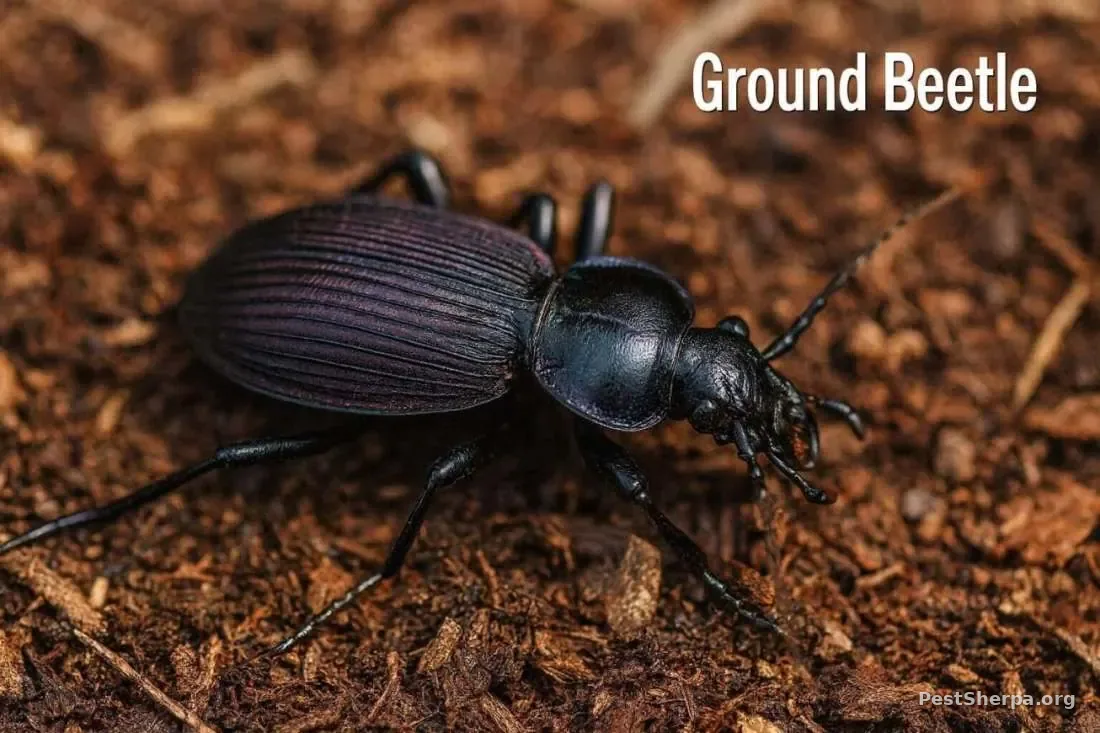
Ground beetles are fast-moving beetles in the family Carabidae. Most are outdoor insects that live in soil, mulch, leaf litter, garden beds, lawns, fields, and wooded areas. They can be startling when they appear indoors because many are dark, shiny, and quick, but they are not structural pests and usually do not reproduce inside homes.
In most yards and gardens, ground beetles are beneficial predators. Many species feed on caterpillars, grubs, fly larvae, slugs, snails, and other small invertebrates. Some also eat weed seeds. When they wander into a house, the best response is usually identification, gentle removal, and exclusion rather than broad insecticide use.
TL;DR
Ground beetles are usually beneficial outdoor beetles. A few indoors usually means they wandered in through gaps, under doors, around lights, or from nearby mulch, grass, leaf litter, or foundation cracks. They do not damage wood, stored food, fabrics, or household belongings. They also do not infest homes in the way cockroaches, pantry pests, or fabric pests can.
The most useful next steps are to vacuum or capture indoor beetles, reduce easy entry points, adjust exterior lighting, and keep heavy mulch or dense vegetation from sitting directly against the foundation. Chemical control is rarely needed.
Quick Navigation
- Ground Beetle Identification
- What Ground Beetles Mean Indoors
- Quick Diagnostic Guide
- Habitat, Behavior, and Life Cycle
- Why They Show Up Around Mulch, Grass, and Lights
- Why Ground Beetles Are Beneficial
- What To Do If You Find Them Indoors
- Prevention and Exclusion
- Pesticides and Safety
- Lookalikes and Common Misidentifications
- Frequently Asked Questions
- References
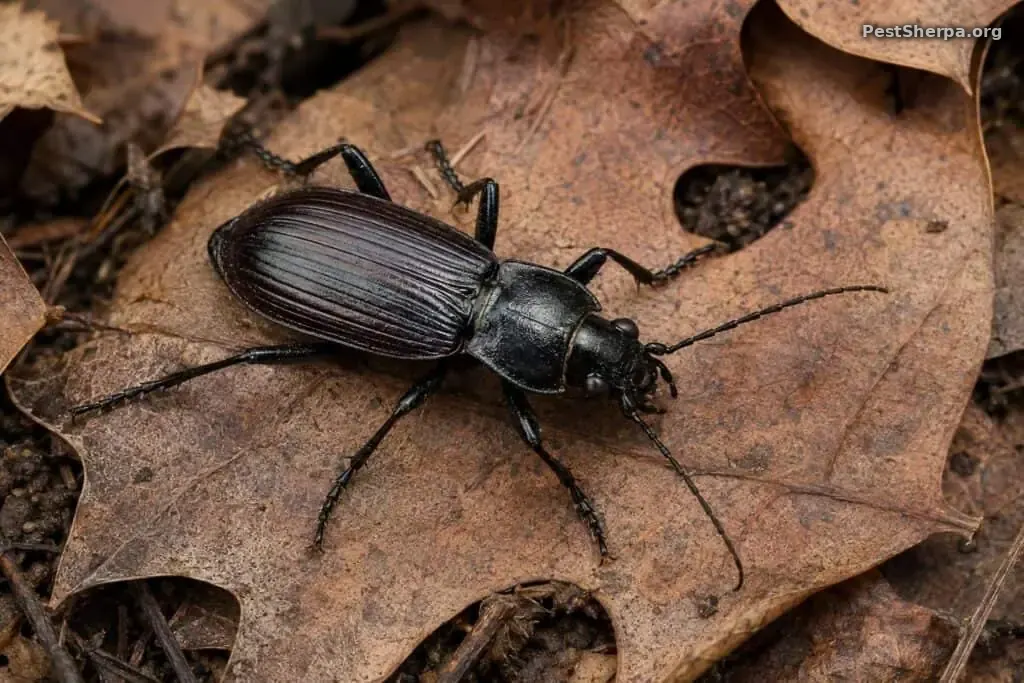
Adult ground beetle on leaf litter near soil.
Ground Beetle Identification
Ground beetles are members of the family Carabidae, one of the largest beetle families in North America. Adults vary widely by species, but many have a similar overall shape: elongated, somewhat flattened, and built for running along the ground.
- Body shape: Usually elongated, oval, and somewhat flattened.
- Color: Often black, dark brown, or reddish brown; some species are metallic green, blue, bronze, copper, or iridescent.
- Legs: Long and strong, allowing them to run quickly when disturbed.
- Antennae: Long, slender, and segmented.
- Mouthparts: Prominent chewing mouthparts used for grasping prey.
- Wings: Hardened forewings, called elytra, meet in a straight line down the back. Some species fly, but many fly rarely or are flightless.
Adult size varies by species. Many common ground beetles are small to medium-sized, while some larger species can be over an inch long. Because the family is so diverse, identification to species often requires close examination of body shape, leg structure, grooves on the wing covers, and other details.
Larvae are usually elongated, darker than many soft-bodied insect larvae, and equipped with chewing mouthparts. They live mostly in soil, thatch, mulch, or under debris, where they hunt small prey or scavenge depending on the species.
What Ground Beetles Mean Indoors
Ground beetles indoors usually mean accidental entry, not an indoor infestation. They may enter under doors, through damaged weather stripping, around garage doors, through cracks near foundations, or through gaps around utility penetrations. Exterior lights can also draw some beetles toward doors and windows at night.
Unlike many household pests, ground beetles are not looking for pantry foods, clothing, wood, or indoor nesting sites. They generally do not survive long indoors because the home lacks the moist outdoor shelter and prey they normally use.
| What You See | What It Usually Means | Best First Step |
|---|---|---|
| One ground beetle indoors | Likely wandered in from outside | Remove it and check nearby door or window gaps |
| Several near a door, garage, or basement | Entry point nearby | Inspect thresholds, sweeps, weather stripping, and foundation cracks |
| Beetles near exterior lights | Night lighting may be attracting them | Reduce bright white lighting or switch to motion-activated lighting |
| Beetles after rain or irrigation | Outdoor shelter may have been disturbed or saturated | Check mulch, leaf litter, drainage, and entry gaps |
| Beetles repeatedly found in one room | Likely nearby entry point rather than breeding indoors | Inspect the exterior wall, sill plate, door, window, or utility openings near that room |
Quick Diagnostic Guide
Use this quick check before assuming ground beetles are a serious indoor pest problem.
| Question | What It Suggests |
|---|---|
| Is the beetle fast-running, shiny, and found on the floor? | Ground beetle is possible |
| Does it have long antennae and hardened wing covers? | Beetle rather than true bug or fly |
| Is it found near doors, garage edges, basement floors, or foundation walls? | Outdoor entry is likely |
| Are there droppings, shed skins, egg cases, or food contamination? | Consider a different pest such as cockroaches or stored-product beetles |
| Are many insects emerging from food, fabric, or wood? | Ground beetles are less likely; investigate pantry pests, fabric pests, or wood-boring insects |
Habitat, Behavior, and Life Cycle
Ground beetles are primarily outdoor insects. They are commonly found under rocks, logs, mulch, leaves, boards, bark, and other protected material. Many are active at night and hide during the day in shaded, moist places.
Most ground beetles hunt at or near the soil surface. Depending on species, they may feed on caterpillars, soft-bodied insects, fly larvae, grubs, mites, slugs, snails, and other small organisms. Some species also feed on seeds, including weed seeds.
Ground beetles undergo complete metamorphosis: egg, larva, pupa, and adult. Eggs are usually laid in soil or organic matter. Larvae develop in soil, litter, or similar protected outdoor places. Pupation typically occurs in the soil. Life cycle timing varies by species and climate, and many species overwinter outdoors as adults or larvae.
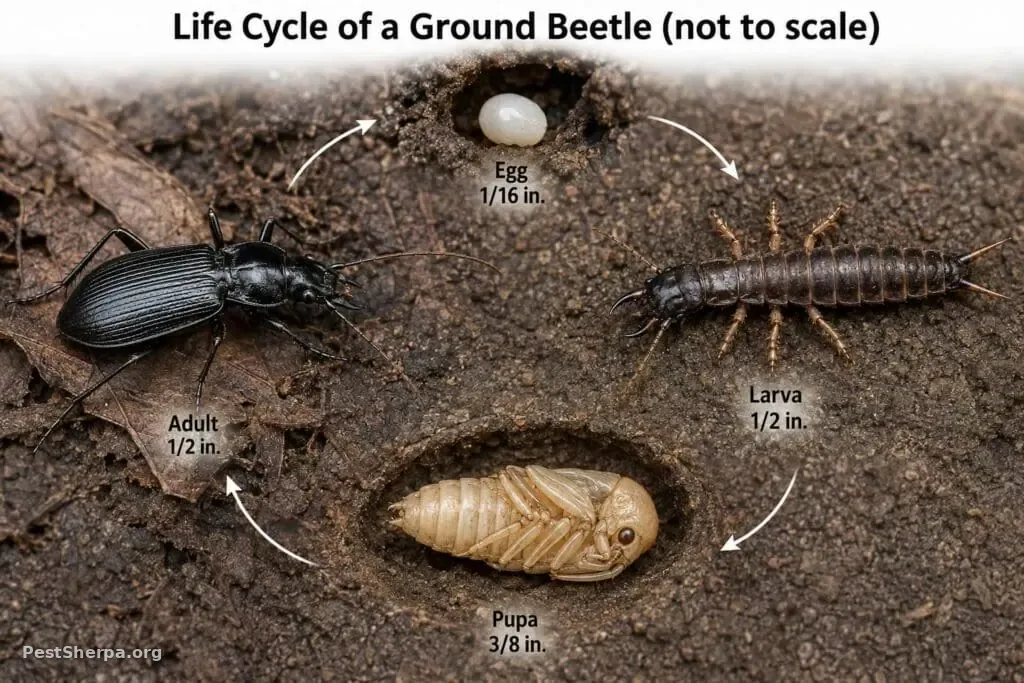
Ground beetle life cycle showing egg, larva, pupa, and adult.
Why Ground Beetles Show Up Around Mulch, Grass, and Lights
Mulch, grass, leaf litter, and garden beds provide the moisture, shelter, and prey that ground beetles use. This is normal outdoor habitat. Problems usually occur when attractive habitat sits directly against doors, basement windows, garage thresholds, or foundation cracks.
Heavy mulch piled against siding, thick vegetation touching the foundation, wet leaf litter in window wells, or gaps below exterior doors can increase accidental entry. Ground beetles may also be noticed more after heavy rain, irrigation, mowing, landscape work, or seasonal temperature shifts.
Some ground beetles are attracted to lights at night. Bright exterior lights near doors and windows can concentrate beetles near entry points even when the beetles are not breeding indoors.
Why Ground Beetles Are Beneficial
Ground beetles are often helpful in lawns, gardens, farms, and natural areas. Many species are generalist predators that feed on insects and other invertebrates at the soil surface. Others consume seeds, including weed seeds, and may contribute to natural weed suppression.
Because they live close to the soil and respond to habitat conditions, ground beetles are also used by researchers as indicators of land-management effects, soil disturbance, crop systems, and habitat quality.
In a home landscape, the goal is usually not to eliminate ground beetles from the yard. A better goal is to keep them outdoors while preserving their beneficial role in garden and soil ecosystems.
What To Do If You Find Ground Beetles Indoors
1. Confirm the Beetle Type
Look for a fast-running beetle with hardened wing covers, long legs, and long antennae. If the insect is flattened, tan to dark brown, active in kitchens or bathrooms, and associated with droppings or egg cases, compare it with the cockroach guide instead.
2. Remove Indoor Beetles
Vacuum them, sweep them into a container, or release them outdoors. Avoid handling beetles directly because some species can release irritating defensive chemicals when disturbed.
3. Inspect Nearby Entry Points
- Door thresholds and sweeps
- Garage door seals
- Basement windows and window wells
- Foundation cracks
- Gaps around pipes, cables, vents, and utility penetrations
- Exterior doors used at night near bright lights
4. Check Outdoor Conditions
Look for thick mulch, wet leaves, dense groundcover, stacked firewood, stones, boards, or debris directly against the foundation. These materials can be useful habitat outdoors, but they should not create a protected pathway into the home.
Prevention and Exclusion
Prevention should focus on keeping ground beetles outside, not removing every beetle from the yard.
- Install or repair door sweeps and weather stripping.
- Repair damaged window screens.
- Seal cracks and gaps around foundations, doors, windows, and utility openings.
- Reduce heavy mulch directly against the foundation, especially near doors and basement windows.
- Remove wet leaf litter from window wells, stairwells, and foundation edges.
- Move firewood, boards, stones, and stored materials away from entry points.
- Use motion-activated lighting or less-attractive exterior lighting near doors when beetles are gathering at night.
- Improve drainage where soil or mulch stays constantly wet against the structure.
In gardens, it is usually better to maintain a diverse landscape with plant cover and organic matter while keeping the immediate foundation edge clean, dry, and well sealed.
Pesticides and Safety
Pesticides are rarely necessary for ground beetles. Since they are beneficial outdoor insects and do not usually reproduce indoors, repeated spraying can create more downside than benefit.
If a labeled pesticide is considered for exterior cracks or entry points, read and follow the product label carefully. Keep treatments away from food-contact surfaces, children, pets, drains, and water sources. Avoid broad applications to gardens, mulch beds, and flowering areas where beneficial insects and other non-target organisms may be exposed.
For repeated indoor entries, exclusion, moisture correction, lighting adjustment, and habitat separation near the foundation are usually more important than insecticides.
Lookalikes and Common Misidentifications
Ground beetles can be confused with several other dark, fast-moving pests. The differences matter because the next steps are not the same.
| Lookalike | How It Differs | Why It Matters |
|---|---|---|
| Cockroaches | Usually flatter, more oval, often associated with kitchens, bathrooms, droppings, egg cases, or sanitation sources | Cockroaches can reproduce indoors and need a different inspection plan |
| House crickets | Long jumping hind legs and often chirping males | Crickets are handled with entry-point correction and habitat reduction, but identification differs |
| Field crickets | Jump rather than run like beetles; darker outdoor crickets may enter seasonally | Seasonal cricket entry can point to lighting and door gaps |
| Camel crickets | Humpbacked body, very long legs, and strong jumping | Often points to damp basements, crawlspaces, garages, or storage areas |
| Earwigs | Pincers at the rear of the body | Often associated with moisture, mulch, and exterior entry points |
| Sowbugs | Many legs, segmented crustacean-like body, slow movement | Usually indicates moisture around foundations, basements, or crawlspaces |
Other dark beetles, including darkling beetles and some stored-product beetles, may also be mistaken for ground beetles. If beetles are emerging from stored food, pet food, birdseed, woolens, animal products, or wood, investigate a different source.
Frequently Asked Questions
Are ground beetles harmful?
Ground beetles are not considered harmful household pests. They do not damage structures, stored food, clothing, or furniture. Some species may release an irritating odor or defensive chemical if handled, so it is best to remove them with a cup, paper, broom, or vacuum.
Do ground beetles bite?
They have chewing mouthparts and could pinch if mishandled, but they are not blood-feeding insects and do not seek out people or pets. Avoid handling them directly.
Why are ground beetles in my house?
They usually wandered in from outdoors. Common reasons include gaps under doors, damaged weather stripping, bright exterior lights, nearby mulch or leaf litter, foundation cracks, and changes in outdoor moisture after rain or irrigation.
Do ground beetles infest homes?
Usually no. Ground beetles are outdoor insects. They may enter homes accidentally, but they normally do not establish indoor breeding populations.
Should I remove mulch to get rid of ground beetles?
You do not need to remove all mulch. Mulch can support beneficial insects and soil moisture. The better approach is to avoid piling thick mulch directly against siding, doors, basement windows, and foundation cracks.
Are ground beetles good for gardens?
Yes. Many ground beetles are beneficial predators of insects and other small invertebrates, and some species also eat weed seeds. Keeping them outdoors while sealing the home is usually the best balance.
What is the fastest way to stop ground beetles from coming inside?
Start with the entry points closest to where you are finding them. Repair door sweeps, seal obvious gaps, clean wet leaf litter from window wells, reduce heavy mulch against the foundation, and adjust exterior lighting near doors.
References
- University of Wisconsin-Madison Extension: Ground Beetles (Carabidae)
- Colorado State University Agricultural Biology: Ground Beetles
- South Dakota State University Extension: Ground Beetles: Predators That Provide Benefits in Agricultural Landscapes
- NC State Extension: The Ground Beetles of Eastern North Carolina Agriculture
- eOrganic: An Introduction to Ground Beetles: Beneficial Predators on Farms
- University of Maryland Extension: Carabid Beetles
This article was written by Greg Baumann, founder of Pest Sherpa, and reflects more than 40 years of professional pest management experience.
About the Author

Greg Baumann | Pest Control Expert
Greg Baumann is the founder of Pest Sherpa and a Pest Control Expert with more than 40 years of professional pest management experience. His articles combine decades of field experience, technical expertise, and science-based guidance to help homeowners identify pests correctly, understand real-world risks, and make informed pest management decisions.
Mission: Identify the pest. Understand the risk. Stop the problem. Prevent the comeback. Know when it’s time to call a professional.