
Joro Spider: Identification, Range and What to Do
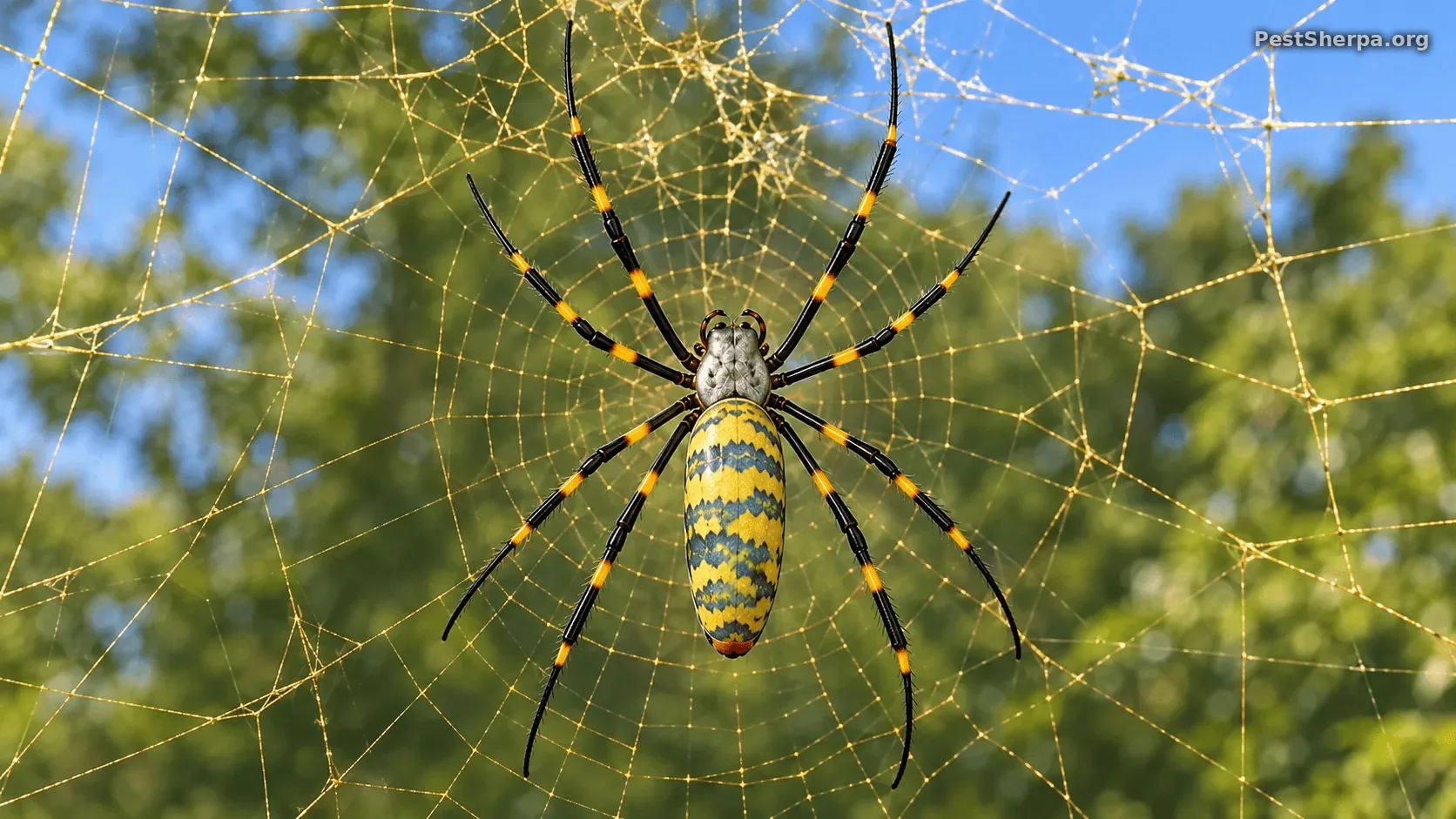
If you’ve walked into a big golden web on your porch in late summer or fall and found a yellow, blue-black and red spider the size of your palm sitting in the middle of it, you’ve probably met a Joro spider. They look like something out of a horror movie, and the headlines haven’t helped. Here’s the plain truth: Joro spiders are a new arrival in the Southeast, they are spreading, and they are about as close to harmless as a big spider gets. This guide covers how to identify one, how to tell it from our native garden spiders, where they are now, and what, if anything, you need to do.
Quick answer: Joro spider at a glance
- What it is: the Joro spider (Trichonephila clavata), a large orb-weaving spider from East Asia, first documented in northeast Georgia in 2014.
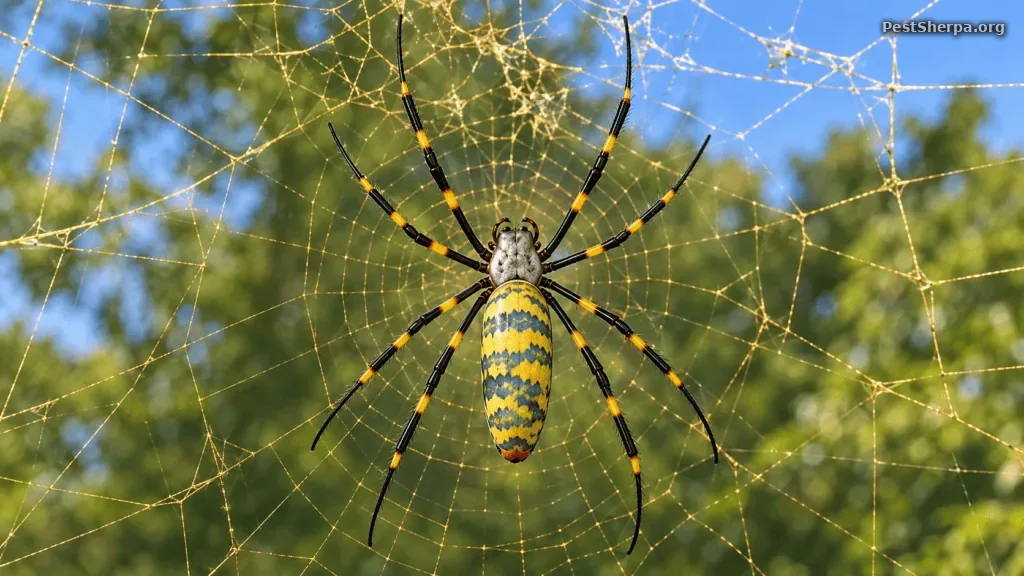
- How to spot a female: bright yellow abdomen with wide blue-black or teal bands across the top, a red patch on the underside near the tail, long black legs banded with yellow, and a body up to about an inch long.
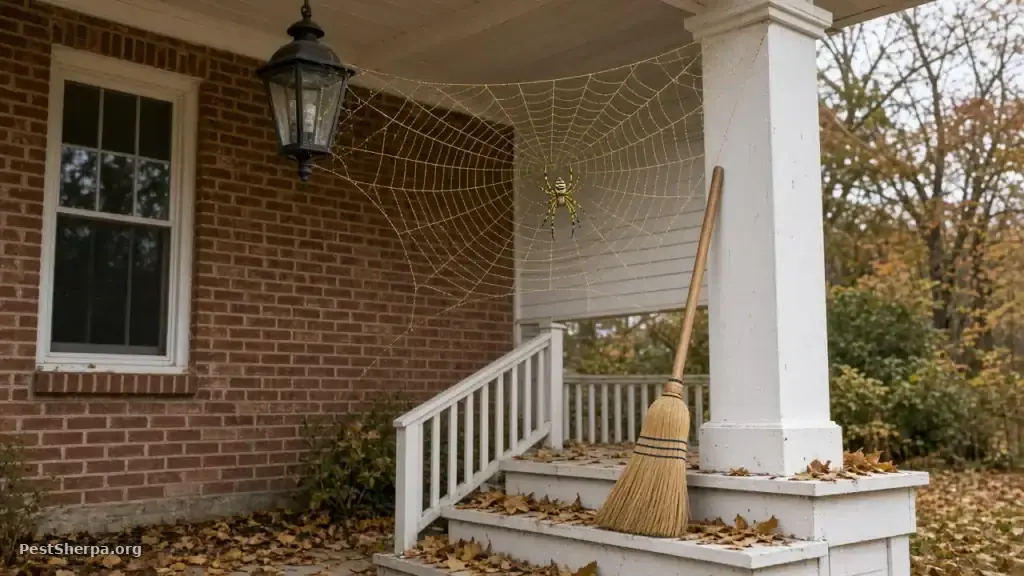
- The web: golden-tinted silk, often at eye level or higher on porches, eaves, trees and power lines, with messy support lines stretching off to the sides.
- Males: small, slim and brown. You’ll often see one or more sitting in a female’s web.
- Danger: venomous like nearly all spiders, but bites are rare and mild. Not considered medically important.
- Season: most noticeable from late August to October. Adults die after the first hard freeze.
Bottom line: you can leave them alone. If a web is in your way, use a broom, not a sprayer. See what to do.
Based on UGA Extension, Clemson HGIC, UT Extension and peer-reviewed research cited in the References below.
How to identify a Joro spider
The adult female is the one everybody notices, and she’s easy to recognize once you know what to look for. Her body can run from about two thirds of an inch to more than an inch long, and with her legs stretched out she can span 3 inches or more, about the size of your palm. [University of Georgia Extension] [Clemson Cooperative Extension HGIC]
| Feature | Adult female Joro spider | Why it matters |
|---|---|---|
| Abdomen (top) | Bright yellow with wide blue-black, teal or bluish-green bands running side to side | The bands are the quickest way to tell a Joro from a golden silk orb weaver |
| Abdomen (underside) | Black and white checkered pattern with red markings near the tail end | A strong Joro clue; the common look-alikes below don’t have it |
| Front body section | Silvery or white on top | Helpful, but the golden silk orb weaver has a pale one too |
| Legs | Long and black with yellow or yellow-orange bands (rarely all black) | No black hair tufts at the leg joints |
| Body length | About 0.67 to 1.2 inches; leg span 3 inches or more | Mature females are much bigger than most native orb weavers |
| Web | Golden-tinted silk, often several feet across, at eye level or higher | Garden spider webs are white and usually knee-high |
Males look like a different spider. An adult male is only about 0.16 to 0.31 inch long, slim and brownish, with darker stripes. Females can weigh hundreds of times more than males, and it’s normal to find one or several males hanging around the edges of a female’s web in late summer. [University of Georgia Extension] [University of Tennessee Extension]
Young Joros are hard to tell apart. Spiderlings and juveniles are smaller, with a mottled silver, black and yellow pattern, and their early webs aren’t golden yet. Most people don’t notice them until August, when the females are nearly grown. [Clemson Cooperative Extension HGIC] [University of Tennessee Extension]
Greg’s tip: If the spider is high up, look at the web first. A big golden web which appears chaotically developed compared to neat organized web, strung across a porch corner, between a gutter and a tree, or along a power line in September could indicate a Joro. Then check for the blue-black bands. You don’t need to get close.
Joro spider vs garden spider and other look-alikes
The Southeast has three native or long-established big yellow orb weavers that people mix up with the Joro. All of them are harmless to people, and all of them eat a lot of insects. Here’s how to tell them apart. [Clemson Cooperative Extension HGIC] [University of Georgia Extension] [University of Tennessee Extension]
| Spider | Abdomen markings | Web | Where you’ll see it |
|---|---|---|---|
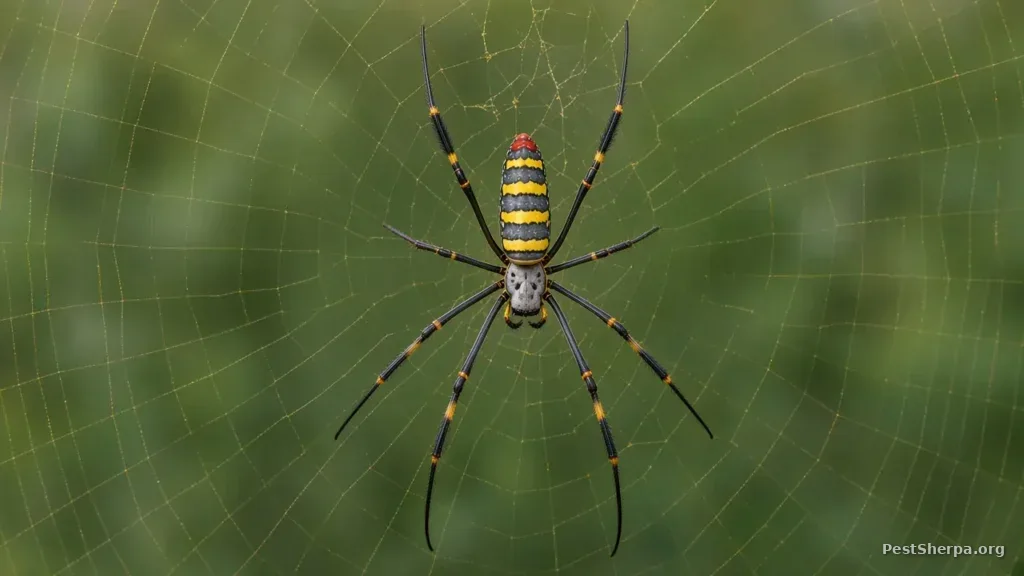
| Joro spider (Trichonephila clavata) | Yellow with wide blue-black or teal bands across the top; red patch underneath | Golden silk, no zigzag, messy support lines on each side | Eye level or higher: porches, eaves, trees, power lines, forest edges |
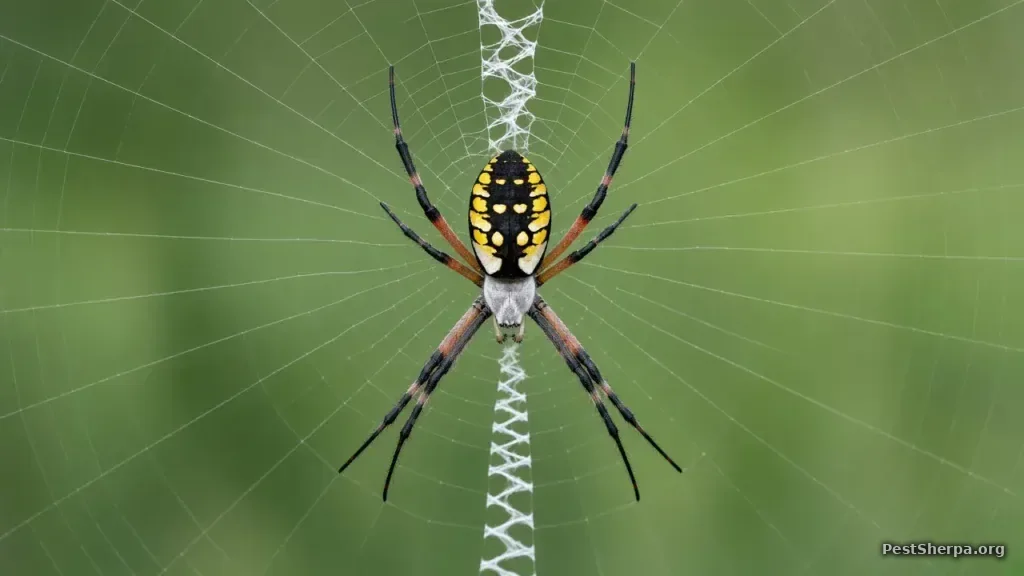
| Yellow garden spider (Argiope aurantia), also called the writing spider | Bright yellow with a black center and black patches, no blue bands | White silk with a thick zigzag down the middle | Knee-high in sunny gardens, tall grass and shrubs |
| Banded garden spider (Argiope trifasciata) | Many thin black, yellow and silvery-white bands | White silk with a zigzag; often rests with legs held in an X | Low, in meadows, old fields and gardens |
| Golden silk orb weaver (Trichonephila clavipes), also called the banana spider | Yellow-orange with rows of silvery white spots, no blue bands | Golden silk, like the Joro | Wooded, humid areas of the warmer Southeast; established here since the 1800s |
The golden silk orb weaver is the Joro’s closest relative and the trickiest look-alike, because both spin golden webs. Look at the legs: the golden silk orb weaver has black “bottlebrush” tufts of hair at the joints of most of its legs, and the Joro doesn’t. The golden silk orb weaver also lacks the Joro’s blue-black bands and red belly patch. [Clemson Cooperative Extension HGIC] [University of Georgia Extension]
Don’t confuse it with the ones that matter: A Joro is nothing like the small, plain brown spiders that hide indoors. If you’re finding small tan or pale spiders in closets, boxes, shoes or wall corners, read the brown recluse guide or the yellow sac spider guide instead, and see the spider guide for the full lineup.
Where Joro spiders are now
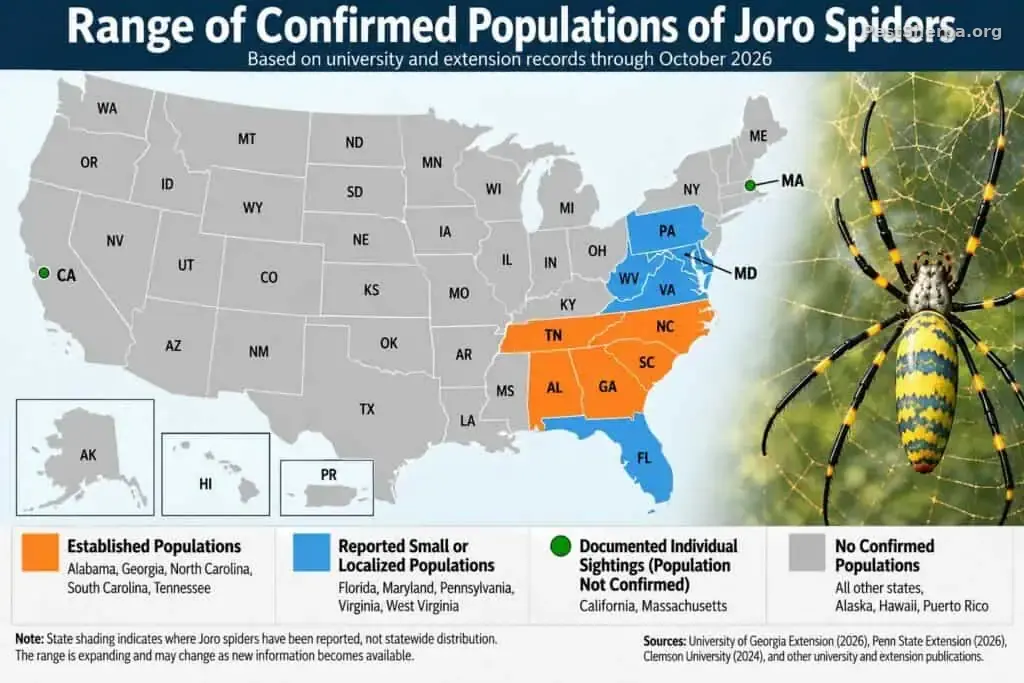
The Joro spider is native to Japan, Korea, China and other parts of East Asia. It was first documented in the United States in 2014 near Braselton and Hoschton, Georgia, along I-85, and researchers think it was probably there for a few years before that, likely arriving as a hitchhiker in shipping cargo. [University of Georgia Extension] [Clemson Extension Forestry and Wildlife]
As of 2026, University of Georgia Extension lists the Joro as established in Georgia, North Carolina, South Carolina, Tennessee and Alabama and spreading into nearby areas, with isolated populations in Maryland, Virginia and Pennsylvania. University of Tennessee Extension also lists reports from West Virginia and Massachusetts, a handful of Florida sightings, and a few questionable single reports farther west. [University of Georgia Extension] [University of Tennessee Extension]
Here in Tennessee, the first Joros were found in Hamilton and Bradley counties in October 2021. By October 2025, the EDDMapS reporting database held about 550 Joro reports from 20 Tennessee counties, according to UT’s urban entomology lab. If you live in East Tennessee and haven’t seen one yet, there’s a good chance you will. [University of Tennessee Extension] [University of Tennessee Entomology and Plant Pathology]
How they spread so fast. Newly hatched spiderlings let out a strand of silk and ride the wind, which is called ballooning, and they can travel long distances that way. Adults can also hitch a ride on cars and trucks. Research from the University of Georgia found Joros handle cold much better than their golden silk cousin, with about double the metabolism and better survival after a brief freeze, and models suggest much of the eastern U.S. is suitable for them. [NC State Extension Forestry] [UGA Today] [Nelsen et al., Ecology and Evolution]
They also don’t seem bothered by people. UGA researchers found Joros living and feeding right next to busy roads, and they’ve been seen on streetlights and even gas pumps. That tolerance for city life is part of why they turn up on houses and porches. [UGA Today] [UGA Today]
When you’ll see Joro spiders
| Time of year | What’s happening |
|---|---|
| April to May | Spiderlings hatch from egg masses; some balloon away on the wind |
| June to July | Juveniles grow in small webs; easy to overlook |
| Late August to September | Females mature, webs get big and golden, males gather in females’ webs |
| Late September to mid-October | Peak season: the time most people notice them |
| Late October to December | Numbers drop; females lay egg masses before the first hard freeze, then the adults die |
| Winter | Only the eggs survive, in fuzzy off-white masses on bark, leaves, siding or deck boards |
Females lay their eggs in the fall in masses that usually hold several hundred eggs. Unlike garden spiders, Joros don’t hang their egg sacs in the web. They glue them under bark, under leaves, or into tight spots on buildings, such as between deck boards. [Clemson Cooperative Extension HGIC] [Clemson Cooperative Extension HGIC] [University of Georgia Extension] [University of Tennessee Extension]
Fall is also when other bugs start pushing toward the house for winter. If you’re seeing stink bugs, lady beetles or boxelder bugs on the siding at the same time, see my overwintering invaders guide.
Are Joro spiders dangerous?
No. Joro spiders are venomous, but nearly every spider is, because venom is how they stun insects for food. Their venom isn’t considered medically important to people or pets. In North America, the spiders that are medically important are the widow spiders and the recluse spiders. [Clemson Cooperative Extension HGIC] [Nelsen et al., Journal of Medical Entomology]
They’re also remarkably shy. In a 2025 study, researchers poked webs, prodded spiders, set them on bare skin and cupped them in their hands. The spiders mostly tried to get away or dropped to the ground, and they bit in 1% or less of those encounters. Bites mostly happened when the spider was pinched. When 23 volunteers let a Joro bite them under medical supervision, pain was low, redness and swelling peaked within minutes, nearly everyone was symptom-free within a day, and no one needed medical care. [Nelsen et al., Journal of Medical Entomology] [University of Tennessee Entomology and Plant Pathology]
UGA Extension’s own team reports that even rough handling while collecting them, such as pinching them into a vial, hasn’t led to bites. If one does bite, expect a small, itchy red welt like a mosquito bite or a mild bee sting. [University of Georgia Extension] [Clemson Cooperative Extension HGIC]
If a Joro spider bites you
- Wash the spot with soap and water.
- A cold pack helps with swelling and itching.
- Expect it to fade within a day or two.
- Get medical care for signs of an allergic reaction, a wound that keeps getting worse, or any symptom that worries you. If you aren’t sure what bit you, read why brown recluse bites are often misdiagnosed.
General first aid. Bite details from Nelsen et al. 2025 and Clemson HGIC. This is general information, not medical advice.
Spider venom myths are nothing new. If you’ve heard the one about the daddy longlegs, I answered it in this Ask the Sherpa question.
Are Joro spiders hurting native spiders?
This is the question I can’t give you a clean answer on, because the scientists don’t agree yet. Here’s where the research stands as of 2026:
- The concern: a 2023 survey found the Joro was the most common orb weaver where it occurred and outnumbered every native species at half of those sites. Native orb weaver diversity was lower near where Joros have lived the longest, though the authors note that human development complicates that finding. Clemson’s forest health specialist says there is mounting evidence that native orb weavers drop off where Joros are thick. [Nelsen et al., Ecology and Evolution] [Clemson Extension Forestry and Wildlife]
- The reassurance: a 2026 University of Georgia diet study compared the stomach contents of Joros and three native orb weavers across Georgia and South Carolina. Their diets were mostly different, Joros ate at least 26 prey types the native spiders didn’t, and native spiders ate the same things whether Joros were nearby or not. The authors concluded that doesn’t suggest strong competition for food. [Grabarczyk and Schmidt, PLOS One] [UGA Today]
- What they eat: mostly small flies and other insects, plus pests like the brown marmorated stink bug. Fortunately, earlier UGA work found Joros tend to avoid monarch butterflies. [UGA Today] [Grabarczyk et al., Frontiers in Ecology and Evolution] [University of Tennessee Extension] [Davis et al., Insects]
Everyone agrees on one thing: Joros are here to stay. Whether they end up crowding out native spiders is still an open question, so expect that answer to change as more research comes in. [UGA Today]
What to do about Joro spiders
My honest advice is the same as most of the researchers’: if a Joro isn’t in your way, leave it alone. It almost never comes inside, it isn’t known to harm people or pets, and it dies with the first hard freeze anyway. [Clemson Cooperative Extension HGIC] [Clemson Extension Forestry and Wildlife]
If one has strung a web across your front door, porch steps, walkway or deck, here’s what works:
- Use a broom, rake or long stick. Wrap the spider up in its web. Just knocking the web down doesn’t last, because a Joro can rebuild it in short order. [University of Georgia Extension]
- Move it far away, or get rid of it. If you’d rather not kill it, carry it on the broom to the edge of the woods or the far side of the yard. A short move isn’t enough, because it will come right back. If you do want it gone, step on it once it’s wrapped and on the ground. [University of Georgia Extension] [Clemson Cooperative Extension HGIC]
- Ignore the high ones. Anything more than about 10 feet up, in treetops or on power lines, isn’t worth the trouble. The higher it is, the better your chances of it landing on your head if you try to remove it. [University of Georgia Extension]
- Clear webs near pollinator gardens and beehives. UGA Extension singles these out as the one place webs shouldn’t stay, because they catch bees and other beneficial insects. [University of Georgia Extension]
Should you spray for Joro spiders?
I don’t recommend it, and neither does UGA. Blanket spraying your yard or the outside of your house kills the beneficial insects and native spiders that keep other pests in check, and it can leave you with worse pest problems than you started with. Once a spray dries on a wall or leaf, it doesn’t do much to a web spider anyway, because the spider never touches it. [UGA Today] [University of Georgia Extension]
If you must spray: If you really can’t use a broom, say a web is up under the eaves, UGA’s tests found that a spider-labeled aerosol sprayed directly on the spider works, and wasp and hornet aerosols are the only ones with enough reach for the eaves. Only use wasp and hornet spray if the product label includes spiders. Spray one spider at a time, use only products labeled for spiders, and follow the label. Clemson specifically warns against spraying things like oils that aren’t intended for spider control use or pesticides not labeled for spider control, and UT Extension says household products such as dish detergent shouldn’t be used outside their intended uses. [University of Georgia Extension] [Clemson Extension Forestry and Wildlife] [University of Tennessee Extension]
Greg’s tip: Read the whole label before you buy any spray, and check that it’s registered in your state. If labels confuse you, you’re not alone. I explained how to read them in this Ask the Sherpa answer, and the Labels and Law section goes deeper. Have leftover cans you don’t need? Here’s how to get rid of old pest control products safely and legally.
What about the egg masses?
From late fall into winter, you may find fuzzy, off-white egg masses glued to siding, deck boards, bark or leaves. Scraping the ones on your house into a bag and throwing them away is optional. It may mean fewer webs on that wall next fall, but it won’t stop new spiderlings from ballooning in from the neighbors’ trees. Make sure it isn’t a native spider’s egg sac first: garden spider sacs are round or teardrop shaped and hang in the old web, while Joro masses are flat and stuck to a surface. [Clemson Cooperative Extension HGIC] [University of Tennessee Extension]
What doesn’t help: Spraying the whole yard, paying for a monthly “spider service” just for Joros, foggers, and spraying household chemicals that aren’t labeled for spiders. They cost money, hit the wrong bugs, and the Joros will be back next year from wherever the wind brings them.
Should you report a Joro spider sighting?
Yes, if you want to help. Researchers are still mapping where Joros are going and how fast, and homeowners’ photos are a big part of that. Two good places to report:
- Joro Watch: Georgia: a monitoring program from the University of Georgia’s Center for Invasive Species and Ecosystem Health. You can report on the site or through the EDDMapS app, and it keeps an up-to-date county map. [Joro Watch]
- iNaturalist: a free app for logging wildlife photos. NC State Extension and Clemson Extension both ask residents to post Joro sightings in those states. [NC State Extension Forestry] [Clemson Extension Forestry and Wildlife]
Take a clear, close photo of the top of the spider, and of the underside if you can, so experts can confirm the ID.
When to call a pro
Rarely is professional expertise needed for Joro control. Joro spiders aren’t a reason for regular pest control service. A pro may make sense if:
- webs keep showing up on second-story eaves, signs or other spots you can’t safely reach with a broom or ladder
- you manage a business, school or rental or own a home where webs over entrances are a constant problem
- you aren’t sure what spider you have, especially indoors, and want a proper identification
If you do hire someone, ask them to remove or spot-treat specific webs rather than spray the whole property. Here’s how to hire a licensed pest control company, and my pest control guide explains what good service should look like.
Common questions about Joro spiders
Are Joro spiders poisonous?
Joro spiders are venomous, not poisonous, meaning that they do have venom as all spiders do, Their venom is not considered medically important to people or pets. In North America, the spiders that matter medically are the widows and the recluses, not the Joro.
Do Joro spiders bite?
Almost never. In field tests, Joro spiders bit in 1% or less of encounters unless researchers pinched them. When volunteers were bitten on purpose under medical supervision, pain was low, redness and swelling faded quickly, and no one needed medical care. A bite usually looks like a mosquito bite or a mild bee sting.
Where are Joro spiders now?
Joro spiders were first documented in northeast Georgia in 2014. University of Georgia Extension lists them as established in Georgia, North Carolina, South Carolina, Tennessee and Alabama, with isolated populations in Maryland, Virginia and Pennsylvania. In Tennessee they were first found in Hamilton and Bradley counties in 2021. See our range map based upon university research in this Pest Guide. You can also check the live maps at Joro Watch or iNaturalist for your county.
How do I get rid of Joro spiders?
For a web across a doorway, porch or walkway, use a broom or stick. Knocking the web down alone doesn’t last, because the spider rebuilds, so either move the spider well away from the house or remove it. Ignore webs high in trees or more than about 10 feet up. Skip blanket yard spraying, which kills the beneficial insects and native spiders you want to keep.
Will Joro spiders die in the winter?
Yes. The adults die after the first hard freeze in late fall or early winter. The species survives the winter as eggs inside fuzzy egg masses stuck to bark, leaves, siding or deck boards, and the spiderlings hatch in April and May.
Can Joro spiders fly?
No. Adult Joro spiders can’t fly or glide. Newly hatched spiderlings can ride the wind on a strand of silk, which is called ballooning, and many native spiders do the same thing. That’s one reason Joros have spread so fast.
Have a spider question I didn’t cover? Ask the Sherpa and I’ll answer it.
References
- University of Georgia Extension: Joro Spider, Trichonephila clavata (Circular 1273)
- University of Georgia Extension: Managing Joro Spiders in the Landscape (Circular 1289)
- Joro Watch (University of Georgia Center for Invasive Species and Ecosystem Health)
- UGA Today: Are Joro spiders outcompeting Georgia’s native spiders? (2026)
- UGA Today: Joro spiders likely to spread beyond Georgia (on Davis and Frick, Physiological Entomology, 2022)
- UGA Today: Joro spiders well poised to populate cities (on Davis et al., Arthropoda, 2024)
- Clemson Cooperative Extension HGIC: The Joro Spider (HGIC 2517)
- Clemson Cooperative Extension HGIC: Big Yellow Spiders in South Carolina (HGIC 2503)
- Clemson Extension Forestry and Wildlife: Joro Spider Q&A (2025)
- University of Tennessee Extension: Joro Spider (W1415, 2026)
- University of Tennessee Entomology and Plant Pathology: Updates on the Joro Spider (Insec(tc)ure newsletter, Oct. 2025, PDF)
- NC State Extension Forestry: Joro Spiders in North Carolina, Everything You Need to Know
- Nelsen et al., Journal of Medical Entomology (2025): Keep calm and carry on: bites from Trichonephila clavata are unlikely and cause minimal discomfort
- Nelsen et al., Ecology and Evolution (2023): Veni, vidi, vici? Future spread and ecological impacts of a rapidly expanding invasive predator population
- Grabarczyk and Schmidt, PLOS One (2026): DNA metabarcoding to estimate diet overlap between the introduced Joro spider and three native orb-weaving spiders
- Grabarczyk et al., Frontiers in Ecology and Evolution (2023): DNA metabarcoding analysis of three material types to reveal Joro spider trophic interactions and web capture
- Davis et al., Insects (2024): Do invasive Joro spiders from Asia avoid eating unpalatable monarch butterflies?
This article was written by Greg Baumann, founder of Pest Sherpa, and reflects more than 40 years of professional pest management experience.
About the Author

Greg Baumann | Pest Control Expert
Greg Baumann is the founder of Pest Sherpa and a Pest Control Expert with more than 40 years of professional pest management experience. His articles combine decades of field experience, technical expertise, and science-based guidance to help homeowners identify pests correctly, understand real-world risks, and make informed pest management decisions.
Mission: Identify the pest. Understand the risk. Stop the problem. Prevent the comeback. Know when it’s time to call a professional.