
Jumping Spiders: Identification, Bites, and What to Do
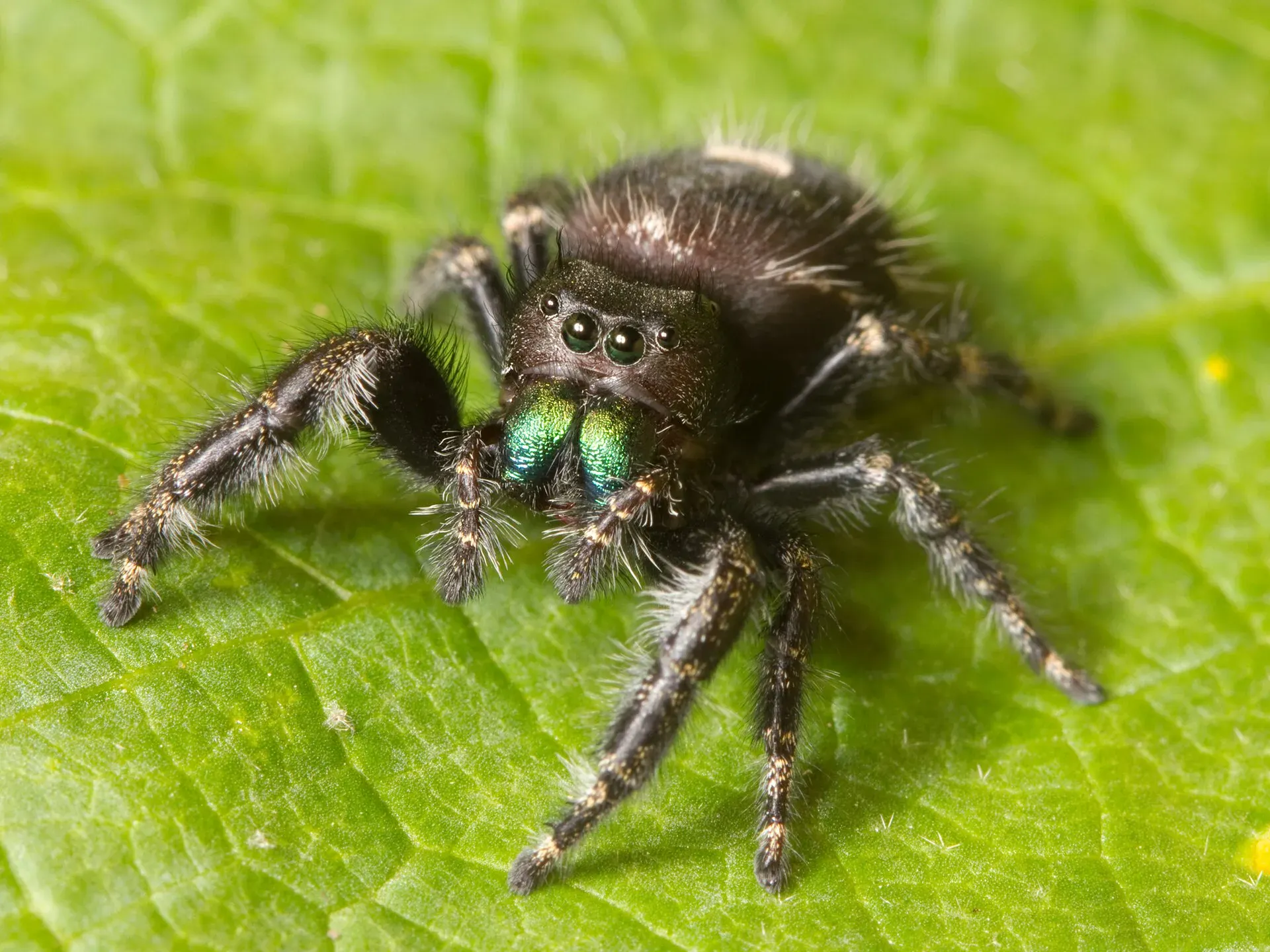
If a compact, fuzzy spider has just hopped sideways across your windowsill and turned to regard you with large forward-facing eyes, you have most likely met a jumping spider. They are common around homes and gardens, they hunt in daylight, and they unsettle people precisely because they appear curious. The facts are reassuring: jumping spiders are beneficial predators, their bites are uncommon and usually mild, and the best response indoors is generally a cup and a sheet of paper rather than a pesticide.
Key Points
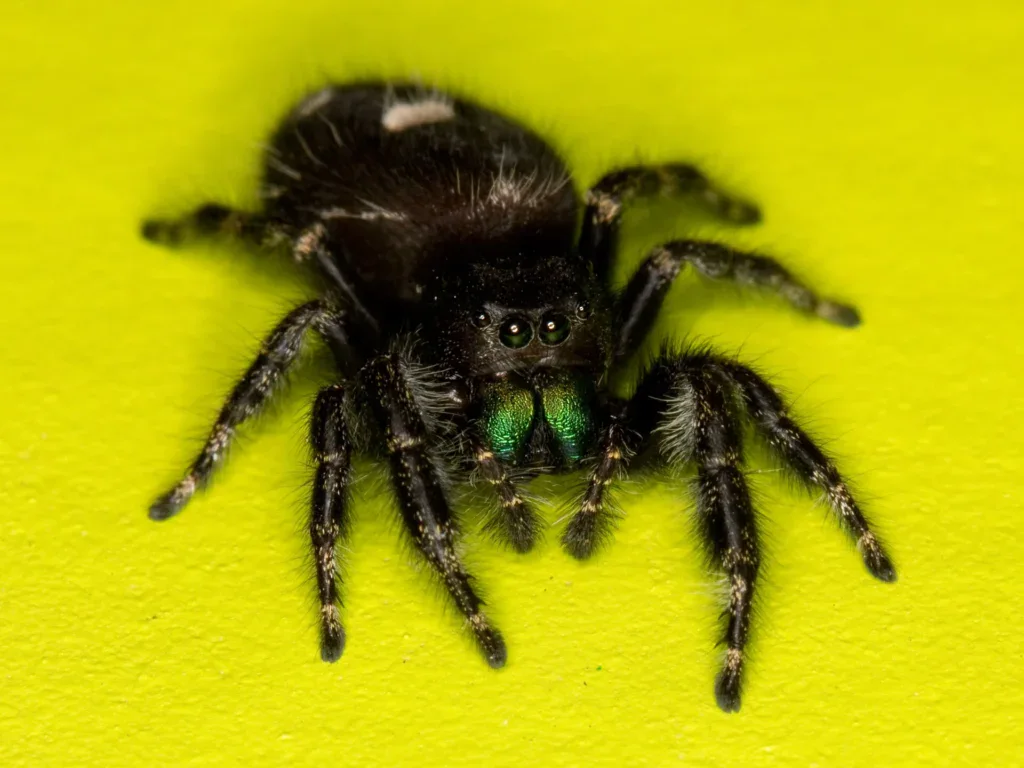
Jumping spiders (family Salticidae) are compact, often hairy daytime hunters with two large front eyes that make them look oddly attentive. Hundreds of species live in North America. The bold jumper (Phidippus audax) is the one homeowners notice most: black with white, yellow, or orange spots, and sometimes iridescent green jaws.
They do not build sticky capture webs. They stalk and pounce on small insects, which makes them useful around the house and garden. They are venomous the way nearly all spiders are, but they are not medically important. Bites are uncommon and usually mild.
Indoors, capture and release them with a cup and paper, or vacuum them up and empty the canister outside, and seal gaps so that fewer wander in. Outdoors, leave them alone unless you need a specimen for identification. Spraying out of alarm is not the answer.
In This Guide
- Identification
- Quick ID Table
- Look-alikes
- Behavior and Life Cycle
- Are They Dangerous?
- What To Do
- Prevention
- When To Call a Pro
- Frequently Asked Questions
- References
How to identify a jumping spider
Jumping spiders are built for sight hunting. They have a distinctive eye pattern in three rows: four eyes in front (the middle pair is large and forward-facing), two tiny eyes in a middle row, and two medium eyes farther back. That face-like look is the fastest way to tell a salticid from a wolf spider or a house spider. [UC IPM] [Penn State Extension]
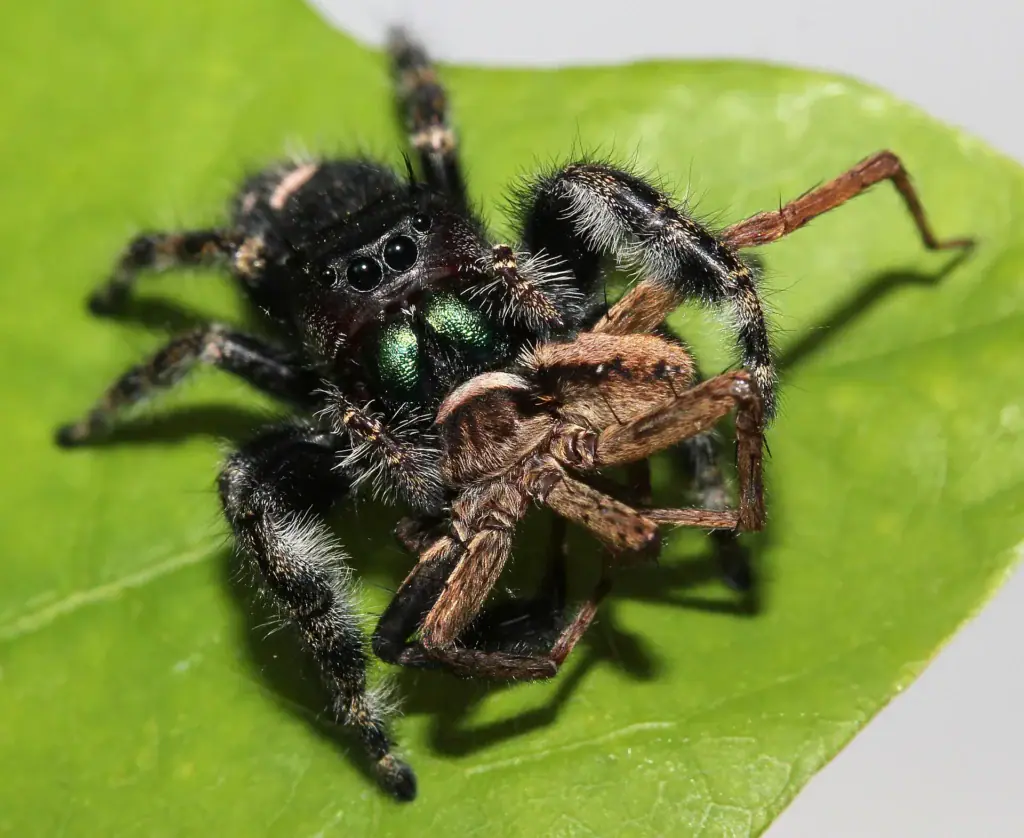
Bodies are short and stout compared with long-legged web spiders. Many species are hairy. The bold jumper, common from the East Coast west toward California, is black with a pattern of white, yellow, or orange spots on the abdomen. Younger spiders often show more orange. The chelicerae frequently shine iridescent green. Males may show tufts of hair over the eyes. Adult females of P. audax run about 8 to 19 mm; males are a bit smaller. [Penn State Extension]
In the Southeast, the regal jumping spider (Phidippus regius) is the largest eastern jumping spider and is sometimes mistaken for a black widow at a glance. A widow is shiny, globose, and long-legged; a Phidippus is hairy and compact. [UF/IFAS Featured Creatures] It is common for anyone to encounter a dark colored spider and assume that it is a black widow. Most times, it is not a black widow and is harmless.
Greg’s tip: If the spider is small, fuzzy, active in daylight, and turns to face you, it is almost certainly a jumping spider. It can also move in jerky motions. You do not need a species name to decide what to do.
Quick ID table
| Feature | Jumping spider | Why it matters |
|---|---|---|
| Eyes | Eight eyes in three rows; two large front eyes | The face-like look separates them from most house spiders |
| Body shape | Short, stout, often hairy | Not the long-legged look of orb weavers or widows |
| Web | No capture web; small silk retreats only | You will not find them in a classic orb or cobweb |
| Activity | Daytime hunters; stalk and pounce | Night-active cellar spiders and many house spiders behave differently |
| Movement | Short hops, quick turns, can walk backward | The hop is a signature field clue |
| Bite risk | Low; mild if it happens | Not in the medically important group with widows and recluses |
Look-alikes
Homeowners frequently confuse jumping spiders with a few other groups. None of the common mix-ups changes the basic advice: identify the spider carefully before reacting, and keep the spider if you believe you were bitten. [UC IPM]
| Look-alike | How it differs | Notes |
|---|---|---|
| Wolf spiders | Longer legs; different eye pattern; ground runners | Also beneficial hunters; see the spider hub for context |
| Black widow | Shiny black, globose abdomen, long spindly legs; hourglass underneath | Medically important; not hairy or compact like Phidippus. [UF/IFAS Featured Creatures] |
| Yellow sac spider | Pale yellow to greenish; nocturnal; rests in silk sacs | More of an indoor nuisance biter in some areas; see the yellow sac spider guide. |
| Brown recluse | Violin mark; six eyes in pairs; hides in undisturbed indoor clutter | Range-limited and medically important; see the brown recluse guide. |
| Joro / orb weavers | Build large webs; sit in the web | Different lifestyle entirely; see the Joro spider guide if you found a big golden web. |
If you are unsure what you have found, use What Bug Is This? or Ask the Sherpa. A clear photograph of the top of the spider, and of the eyes if you can manage it, is very helpful. For the broader lineup of species, begin with the spider guide.
Behavior and life cycle
Jumping spiders hunt by sight. They stalk prey, then jump many times their body length, trailing a silk safety line. They need daylight to hunt, which is why you see them on windowsills, deck rails, tree trunks, and sunlit walls. [Penn State Extension] [UC IPM]
They do not spin capture webs. Females lay eggs in a silken sheet inside a retreat. Penn State notes that bold jumpers overwinter as nearly mature individuals, mature in spring, and deposit eggs in early summer. [Penn State Extension]
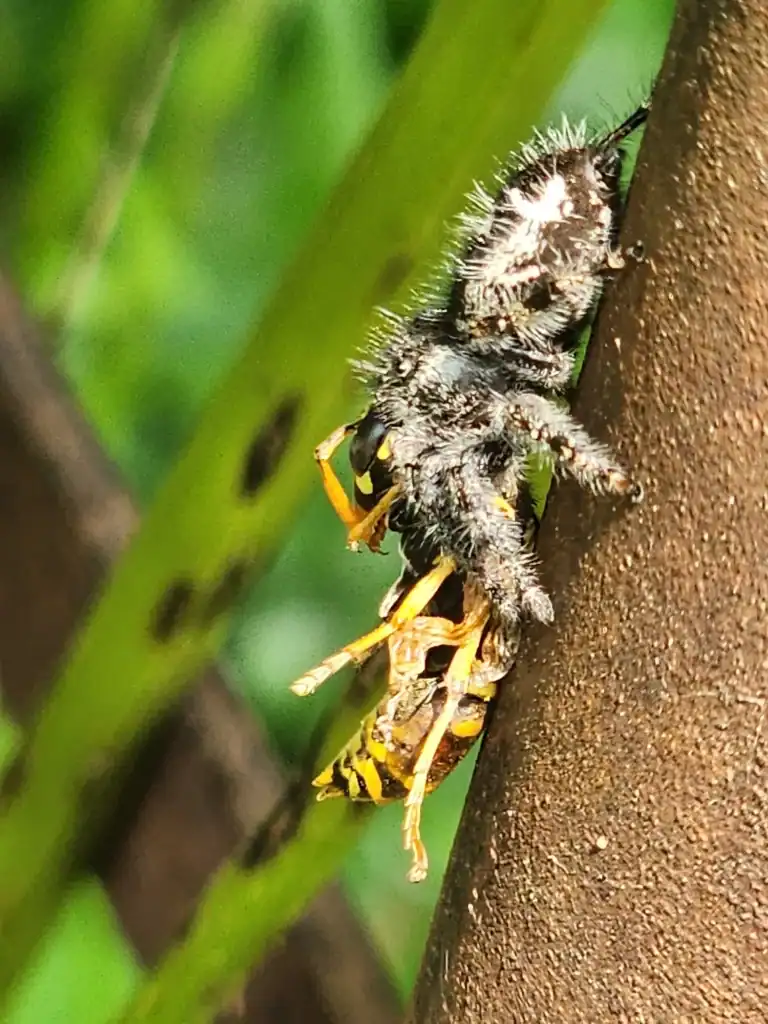
Indoors, they usually wander in through open doors or gaps around windows, or arrive on houseplants and firewood. They do not nest in your walls as some social insects do, and a single spider on a windowsill is an incidental visitor rather than an infestation.
Are jumping spiders dangerous?
No, not in any practical sense for a homeowner. They are venomous, as nearly every spider is which the spiders use to neutralize prey, but extension sources regard them as beneficial and not a health hazard. Larger Phidippus species can deliver a painful bite if held tightly, but the sharp sensation usually fades within minutes and requires no special treatment. [UF/IFAS Featured Creatures] [Penn State Extension] [Utah State University Extension]
If a jumping spider bites you
- Wash the spot with soap and water.
- A cold pack helps with sting and swelling.
- Watch for unusual spreading redness, fever, or an allergic reaction, and get medical care if that happens.
- If you are not certain what bit you, capture the spider for identification when you can, and read in the brown recluse guide why unexplained necrotic wounds are so often misdiagnosed. It is nearly impossible for medical professionals to look at a bite and identify the exact source.
This is general first aid information, not medical advice.
What to do about jumping spiders
My advice is consistent with extension guidance: protect them outdoors, and move them outside when they come indoors. They are beneficial and assist in controlling insects.
- Catch and release. Place a clear cup over the spider, slide paper underneath, and carry it outside to a shrub or fence. USU specifically recommends this approach. [Utah State University Extension]
- Vacuum if you prefer. Vacuum the spider, then empty the canister or bag outdoors so it does not crawl back out inside.
- Skip broadcast sprays. Perimeter fogging and indoor space sprays kill beneficial predators and do nothing to stop the next spider from walking in. If you ever use a product, which should not be a first choice, read the entire label and confirm that spiders are listed. See the Labels and Law section.
- Leave outdoor jumpers alone. On decks, in gardens, and on exterior walls, they are working on your behalf by eating flies and other pests. [UC IPM]
What not to do
- Do not crush every spider on sight; you lose a natural predator and gain nothing.
- Do not assume that a black, hairy spider is a widow; check the body shape and the legs.
- Do not sign up for a monthly pest control service simply because you saw one jumping spider on a windowsill.
- Do not use unlabeled homemade mixtures as pesticides, indoors or outdoors. Use methods that are proven effective, and ignore the home remedies circulating on online forums.
Prevention
Jumping spiders arrive by following prey insects and by using clutter and open gaps far more than they “invade.” Exclusion is more effective than spraying.
- Seal gaps around doors, windows, pipes, and utility penetrations.
- Repair window and door screens, and add or replace door sweeps so that the threshold actually closes.
- Reduce clutter along baseboards and in storage areas where retreats form.
- Shake out shoes, gloves, and rarely used clothing stored on the floor.
- Inspect firewood and potted plants before bringing them indoors.
- Shift porch lighting toward fixtures that attract fewer insects, so that fewer prey insects draw hunting spiders to the door.
These habits also help with other occasional invaders. If insects are pushing toward the house in the fall at the same time, see the overwintering invaders guide. For broader context on spiders, begin with the spiders hub.
What not to do: do not fog a living room over a single jumping spider. Do not crush every hunting spider you see outdoors, since they earn their keep by eating flies and other small pests. And do not treat a mild bite as a brown recluse emergency when no spider has been identified.
When to call a pro
For jumping spiders alone, the answer is almost never. Call a licensed company if:
- you have many spiders indoors and exclusion has not helped; you are scared or your children are scared
- you need a confirmed identification after a bite, or for peace of mind; or
- other pests, such as flies, pantry insects, or moisture problems, are drawing predators indoors.
Here is how to hire a licensed pest control company, and the pest control guide describes what sound service should look like.
Kids, pets, and curiosity
Jumping spiders tolerate observation better than most spiders because they rely on their vision. That does not make them pets, and it does not mean children should pick them up with bare hands. A clear jar can turn a fright into a brief science lesson, after which the spider goes back outside on a plant. Pets usually ignore them, although a curious puppy that mouths a large Phidippus could receive a defensive bite comparable to a minor sting.
If your household’s concern is really about recluses or widows, assess those risks by geographic range and habit rather than by every dark spider on a windowsill. The spider guide keeps the medically important species in perspective alongside beneficial hunters such as jumping spiders.
Jumping spiders around the house and yard
Most encounters with jumping spiders occur in one of three places: a sunny windowsill, a porch railing, or a garden plant. Jumping spiders follow their prey, and their prey follows light and flowers. That is why a kitchen window left open during the summer becomes a thoroughfare for spiders, and also why a single spider on the glass does not mean your walls are full of nests. [Utah State University Extension] [Penn State Extension]
Outdoors, they earn their keep. Flies that bother a patio, small moths around a light, and even other spiders can become their prey, which is why UC IPM’s materials on garden spiders place jumping spiders among the species to protect. If your goal is to use fewer pesticides in the landscape, leaving daytime hunters alone is an easy place to start.
Indoors, think in terms of exclusion and removal rather than eradication. A condominium with worn door sweeps will see more of every wandering arthropod, jumping spiders included. Repair the building envelope, and sightings will decline for spiders, earwigs, and the fall invaders covered in the overwintering invaders guide.
Bite myths, poison vs venom, and medical context
People often ask whether jumping spiders are poisonous. The accurate term is venomous: a poison is swallowed or absorbed, while venom is injected. Nearly all spiders use venom to subdue their prey, but the medically important species in North America form a much smaller group, chiefly the widows and the recluses. Extension guidance does not place jumping spiders on that list.
UF/IFAS notes that large Phidippus spiders can bite if held tightly and that the sensation is a sharp sting that fades within minutes. That is consistent with what I have always told homeowners: uncomfortable, but not a reason for a trip to the emergency room. Allergic reactions to any arthropod bite are possible, so use judgment and seek medical care if symptoms escalate. [UF/IFAS Featured Creatures]
If a wound is necrotic or slow to heal and no one captured the animal, resist the temptation to blame a spider. Secondary infections, other arthropods, and skin conditions unrelated to bites are common causes. The brown recluse guide explains how often the brown recluse is blamed far outside its range.
Simple monitoring
Sticky monitors placed along baseboards show you what is actually moving across the floors at night. Because jumping spiders are active during the day, they appear on these traps less often than house spiders and ants. A jumping spider on a windowsill with nothing on the traps usually indicates an incidental daytime visitor. Many different spiders together with insects on the traps, by contrast, point to an indoor food supply, such as moisture flies or pantry pests, that should be corrected first.
That food supply is the key. If you kill every spider but leave the drain flies, new predators will soon take their place, which is why sanitation and moisture control are the mature form of spider control. You will find more on small flies in the flies hub.
Common questions about jumping spiders
Are jumping spiders poisonous?
Jumping spiders are venomous, like nearly all spiders, because venom is how they subdue insects. Their venom is not considered medically important to people or pets. A bite, when it happens, is usually minor and short-lived.
Do jumping spiders bite people?
Rarely. They are shy daytime hunters that usually retreat when approached, and bites almost always occur when a spider is pinched, trapped in clothing, or pressed against the skin. Expect a sharp sting that fades within minutes to a day, similar to a mild bee sting.
Are jumping spiders good or bad?
They are beneficial. As predators, they eat flies, mosquitoes, moths, and other small insects around the house and garden, and UC IPM and other extension programs encourage protecting spiders in the landscape for that reason.
Why is a jumping spider staring at me?
Their large front eyes give them excellent vision. They turn to face movement and may watch you from a windowsill or railing, but that attentive look is hunting behavior, not aggression.
How do I get rid of jumping spiders indoors?
Capture and release the spider with a cup and a sheet of paper, or vacuum it and empty the canister outside. Seal gaps, repair screens, and reduce clutter. Avoid blanket spraying, which kills beneficial predators and does not keep new spiders out.
What is the bold jumper?
Phidippus audax is the bold jumper, one of the most common large jumping spiders around homes in much of the U.S. Adults are black and hairy with white, yellow, or orange spots on the abdomen and often iridescent green chelicerae (jaws).
Do jumping spiders make webs?
They do not build capture webs like orb weavers. They hunt by stalking and pouncing. They do spin small silk retreats for resting and for egg sacs, often in corners, under bark, or in wall cracks.
Are jumping spiders the same as wolf spiders?
No. Wolf spiders are longer-legged ground runners with different eye patterns. Jumping spiders are compact, often brightly marked, and have two very large front eyes that give them a face-like look.
Have a spider question I did not cover? Send it to Ask the Sherpa, and I will answer it.
References
- Penn State Extension: Bold Jumper Spider
- UC IPM: Spiders
- UC IPM: Common Garden Spiders
- UF/IFAS Featured Creatures: Regal Jumping Spider (EENY-152)
- Utah State University Extension: Jumping Spiders
This article was written by Greg Baumann, founder of Pest Sherpa, and reflects more than 40 years of professional pest management experience.
About the Author

Greg Baumann | Pest Control Expert
Greg Baumann is the founder of Pest Sherpa and a Pest Control Expert with more than 40 years of professional pest management experience. His articles combine decades of field experience, technical expertise, and science-based guidance to help homeowners identify pests correctly, understand real-world risks, and make informed pest management decisions.
Mission: Identify the pest. Understand the risk. Stop the problem. Prevent the comeback. Know when it’s time to call a professional.