
Opossums: Identification, Signs, and How to Get Rid of Them Humanely
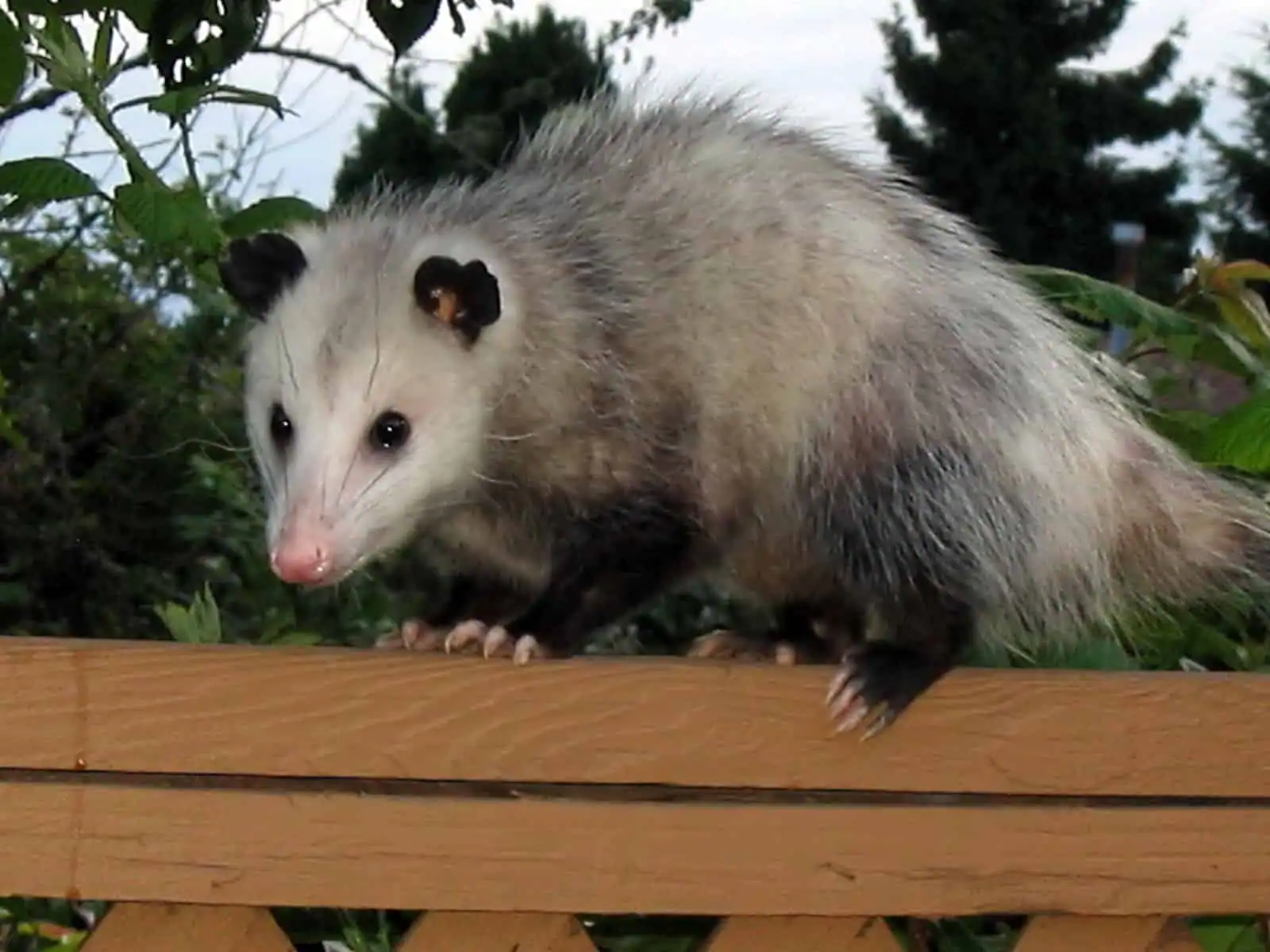
The Virginia opossum is the only native marsupial found in the United States and Canada. This cat-sized omnivore has a pointed white face, mostly hairless ears, and a long, nearly hairless tail. It moves through many neighborhoods unnoticed, feeding on fallen fruit, insects, snails, carrion, and pet food left outdoors. Trouble can begin when one takes shelter beneath a deck, porch, shed, or crawl space, or encounters the family dog. This guide explains how to identify an opossum, understand the actual risks, and discourage it from returning.
Key Points
The Virginia opossum (Didelphis virginiana) is about 2 to 3 feet (61 to 91 cm) long, including its tail. Most adults weigh 4 to 7 pounds (1.8 to 3.2 kg), although large males may reach 15 pounds (6.8 kg). Opossums are primarily nocturnal, eat both plant and animal foods, and possess 50 teeth, more than any other native North American land mammal. When threatened, they may hiss, growl, or display their teeth. Under extreme stress, an opossum may involuntarily enter a motionless state commonly called “playing possum.”
The most dependable way to prevent problems is to remove food sources, confirm that an animal has left its den, and seal access beneath structures with sturdy metal screening. University of California IPM recommends 1/4-inch (6-mm) hardware cloth for closing openings because it also excludes rats and mice. The Internet Center for Wildlife Damage Management (ICWDM) reports that no repellents or toxicants are registered for opossum control and that frightening devices do not provide reliable long-term results.
Trapping and relocation are regulated differently among states. California prohibits relocating wildlife without written permission, and Virginia prohibits trapping wildlife and releasing it in another area. Opossums may carry fleas, ticks, and disease-causing organisms, so homeowners should avoid direct handling and prevent confrontations with pets. UC IPM Pest Notes | Virginia Department of Wildlife Resources
In This Guide
- How to Identify an Opossum
- Signs of an Opossum Around Your Home
- Damage
- Health Risks
- How to Get Rid of Opossums
- What Does Not Work
- Laws and Relocation
- When to Call Licensed Wildlife Control
- What a Pro Visit Looks Like
- What It Costs
- Common Questions
- References
How to identify an opossum
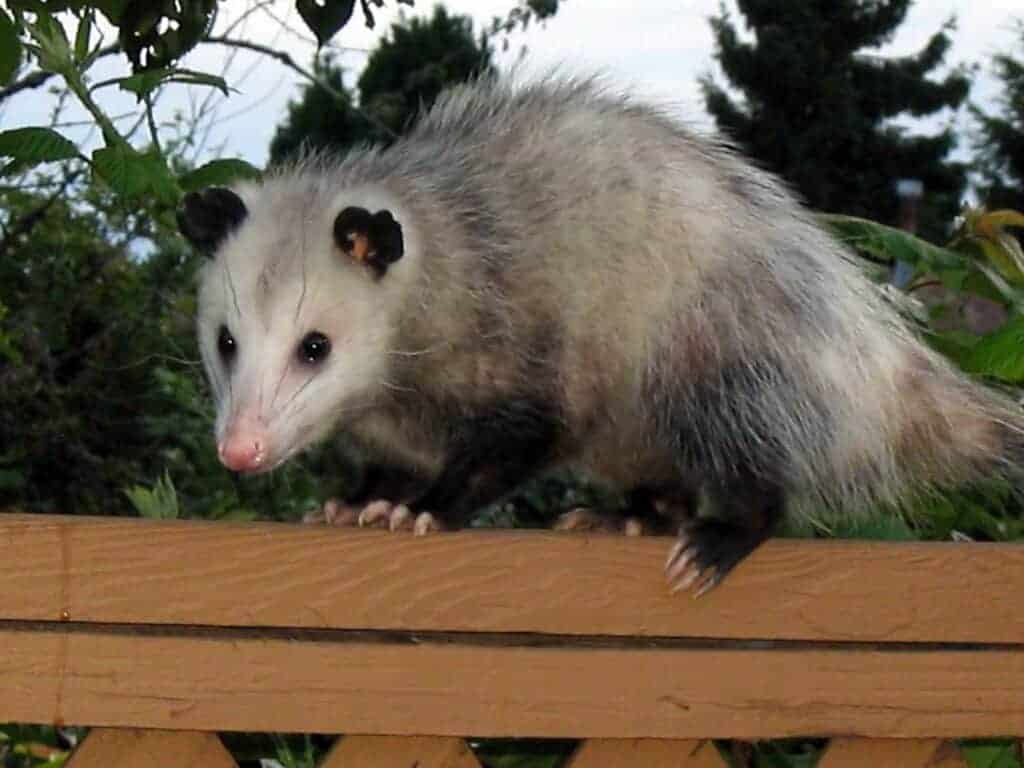
Size and build: Approximately the size of a house cat, with a stocky body, short legs, and a total length of 2 to 3 feet (61 to 91 cm), including the tail.
Fur: Generally coarse and grayish, with coloration ranging from pale gray or whitish to nearly black. Much of the grizzled appearance comes from dark guard hairs over lighter underfur.
Face and ears: A long, pointed muzzle with a predominantly white face, small dark eyes, and rounded, nearly hairless ears. In colder climates, exposed ears may be damaged by frostbite.
Tail: Long, nearly hairless, and prehensile, meaning it can grasp objects. Opossums use the tail to help maintain balance, grip branches, and carry nesting material. Contrary to a popular misconception, adult opossums do not routinely hang upside down by their tails.
Feet: Five widely spread toes on each foot. The hind foot has a distinctive opposable, clawless inner toe that helps the animal grip branches and produces a recognizable track.
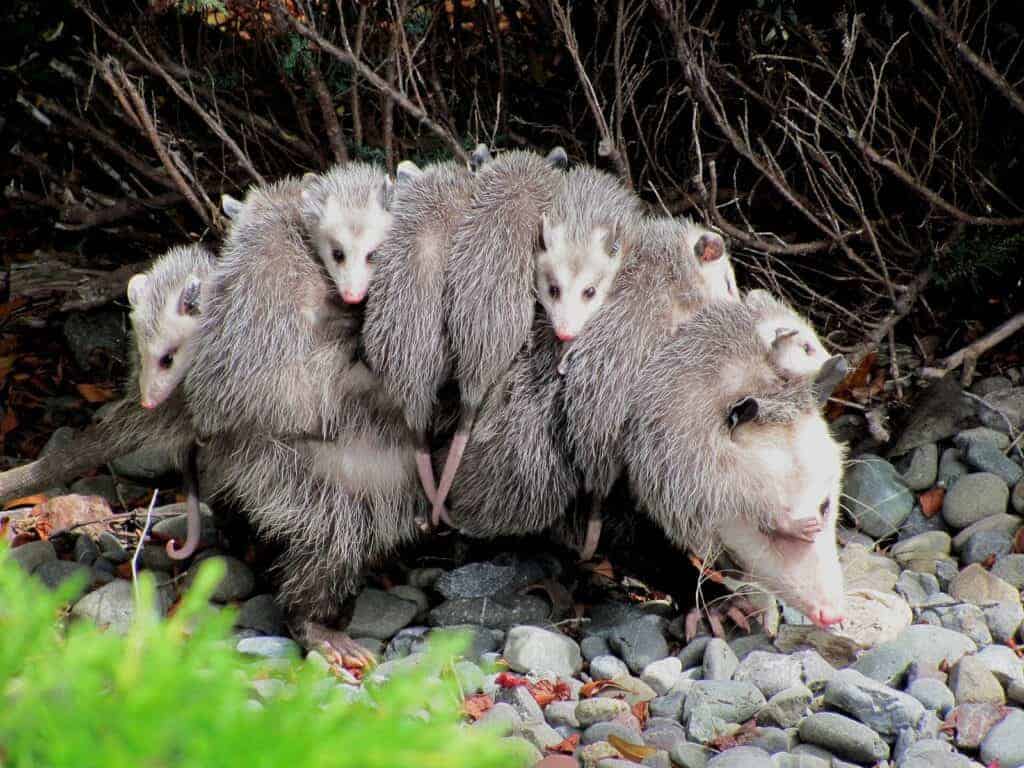
Opossums generally produce one or two litters annually, depending on location and climate. Following a gestation period of approximately 13 days, the tiny, incompletely developed young crawl into the mother’s pouch and attach to a nipple.
Young remain attached for approximately eight weeks. As they develop, they begin making short trips outside the pouch, eventually riding on the mother’s back when they become too large to fit comfortably inside. Weaning generally occurs around 14 weeks, with some variation.
Opossums are relatively short-lived mammals. Mortality is particularly high during the first year, and few survive longer than three years in the wild.
UC IPM Pest Notes | North Carolina Wildlife Resources Commission
Signs of an opossum around your home
- Pet food disappearing overnight: Opossums readily eat food intended for cats or dogs. Nighttime barking may indicate that a pet has encountered visiting wildlife.
- Disturbed garbage, compost, or fallen fruit: Opossums are opportunistic feeders and may scatter food scraps while foraging.
- Droppings on paths, patios, or beneath structures: Opossum droppings vary considerably in size, shape, and texture because of their diverse diet. Droppings alone are not a reliable species identification.
- Distinctive tracks: Opossums leave five-toed tracks. The hind foot has an opposable inner toe that points noticeably away from the other toes, often making the track recognizable in mud or soft soil.
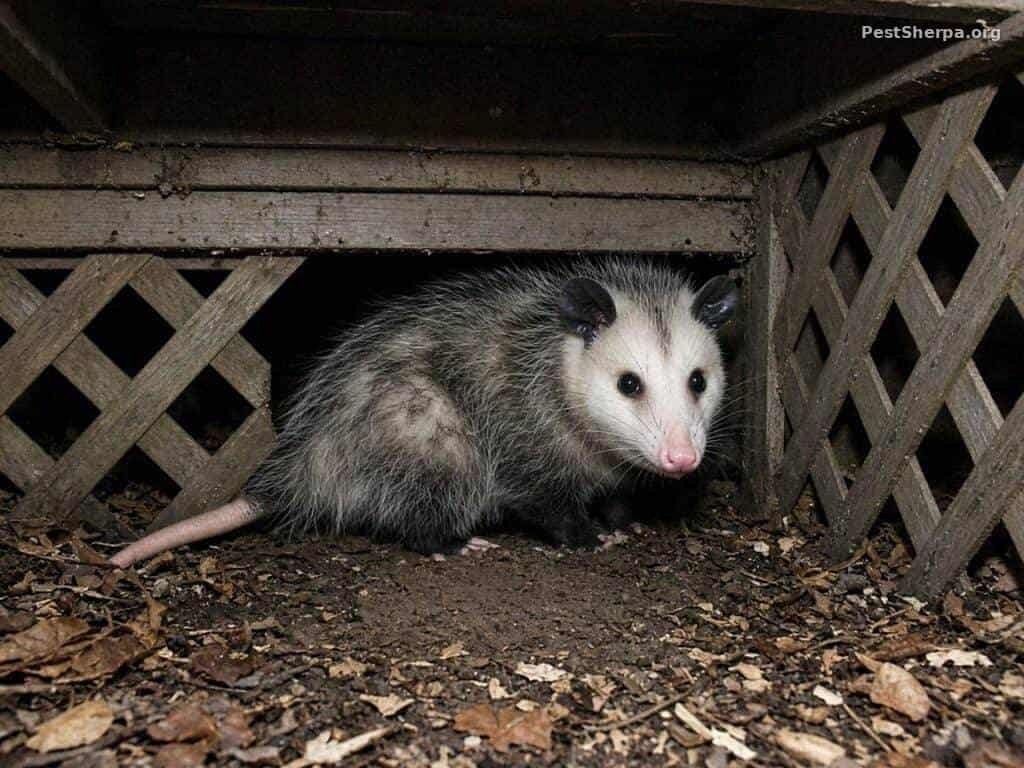
- Nesting material in sheltered locations: An untidy accumulation of leaves, sticks, grass, or other available material beneath a porch, deck, shed, or inside an accessible crawl space may indicate a den.
These signs are suggestive, but several other animals, including raccoons, skunks, and rodents, can produce similar evidence. A photograph, direct sighting, or clearly identified track is more reliable than assuming the species from scattered food or droppings.
Opossums generally do not excavate extensive burrow systems of their own. Instead, they use abandoned burrows created by other animals, natural cavities, brush piles, and sheltered openings beneath buildings. They may occasionally enlarge or disturb an existing opening.
A freshly excavated tunnel beneath a slab or deck may indicate another burrowing animal, such as a groundhog or skunk. Confirm which species is responsible before selecting a control method.
Damage
Most opossum damage around homes is a nuisance rather than a serious structural problem.
Opossums feed on berries, grapes, tree fruit, nuts, and other available food. They may disturb garbage, visit compost piles, and leave droppings on patios, garden paths, and walkways.
Opossums also may enter poultry enclosures to consume eggs or young birds and occasionally attack adult chickens, particularly when birds are accessible at night.
In residential settings, an opossum may enter through a pet door, an uncovered crawl space vent, or another opening. When it gains access to an attic, shed, or crawl space, it may use insulation, leaves, or other materials to construct a sheltered resting place.
Because opossums generally use existing openings rather than excavating extensive burrows, they are less likely to undermine foundations than animals such as groundhogs. However, their presence in enclosed structures may result in contamination from urine and droppings, disturbed materials, and undesirable encounters with pets.
Preventing access to food and shelter is usually more effective than repeatedly removing visiting animals.
Health risks
Opossums can carry disease-causing organisms and external parasites, including fleas, ticks, mites, and lice.
UC IPM identifies several infections associated with opossums, including leptospirosis, tularemia, spotted fever, toxoplasmosis, and other diseases. However, the ability to carry a pathogen does not mean that every opossum is infected or that casual observation of one creates a significant health risk.
The relevant exposure depends on the disease and may involve contact with contaminated materials, bites, or arthropod vectors.
Opossums can host cat and dog fleas. UC IPM notes particular concern about flea-borne typhus in portions of Southern California, where opossums and their fleas can contribute to environments that support transmission.
Prevent direct contact with opossums and avoid handling their droppings without appropriate protection. Keep pets on veterinarian-recommended flea and tick prevention.
Although opossums can contract rabies, cases are uncommon compared with species such as bats, raccoons, skunks, and foxes.
Daytime activity alone is not evidence of rabies. Opossums may forage during daylight, and their normal defensive behavior can include hissing, drooling, and exposing their teeth.
An animal showing persistent disorientation, paralysis, repeated circling, or other seriously abnormal behavior should not be approached. Contact local animal control, a wildlife agency, or a licensed wildlife rehabilitator for guidance.
If an opossum bites or scratches a person, immediately wash the wound thoroughly with soap and running water for 15 minutes and promptly contact a healthcare professional or local health department for an exposure assessment. Any pet bitten by an opossum should be evaluated by a veterinarian.
If pets spend time outdoors at night, maintain appropriate parasite prevention and see our tick guide for information about tick exposure.
How to get rid of opossums
1. Remove the food
Removing accessible food is the first and often most effective step in discouraging opossums.
Bring pet food indoors by nightfall. Use garbage containers with secure, tight-fitting lids, and avoid placing meat, table scraps, or other attractive food waste in open compost piles.
Pick up fallen fruit regularly and modify bird feeders to reduce seed accumulating on the ground.
Protect poultry by closing and securing coops before dark. Store feed in containers that wildlife cannot open.
Virginia’s Department of Wildlife Resources recommends eliminating intentional and unintentional wildlife feeding and encouraging neighbors to do the same.
2. Remove cover
Opossums seek sheltered locations where they can rest without disturbance.
Remove unnecessary brush piles, maintain orderly storage areas, and tightly stack firewood so large sheltered openings are not created.
Keep lumber and other stored materials approximately 18 inches (46 cm) above the ground where practical.
Trim branches that overhang roofs to provide approximately 5 feet (1.5 m) of clearance. This can reduce convenient climbing routes, although opossums may still climb walls, fences, and other structures.
Reducing access to shelter is especially important beneath decks, porches, garden sheds, and crawl spaces.
3. Confirm the opossum is out, then seal
Before blocking an opening beneath a deck or building, confirm that no animal remains inside.
One monitoring method described by UC IPM is to spread a smooth layer of flour approximately 1/8 inch (3 mm) thick immediately outside the suspected entrance. Inspect the tracking patch soon after dark for footprints indicating movement.
However, tracks leading away from the opening show only that an animal exited. They do not establish that the entire den is empty or that the animal will not return.
Opossums often carry dependent young in their pouch or on their back. Nevertheless, older young may temporarily remain in a sheltered location while the mother forages.
Do not permanently seal an entrance until you have confirmed that all animals, including any dependent young, have left.
Where appropriate, a properly installed one-way exclusion door may allow animals to exit without returning. ICWDM describes a door assembly approximately 6 by 6 by 10 inches (15 × 15 × 25 cm) for opossum exclusion.
Before using one-way exclusion, check for dependent young, identify all openings, and ensure that other animals cannot become trapped. Monitor the site for several days before permanently sealing it.
If the presence of young is uncertain, consult a qualified wildlife professional rather than risking separating the mother and her young.
Exclusion specs that work
Openings beneath structures: Use securely attached, galvanized 1/4-inch (6-mm) hardware cloth to seal access beneath decks, porches, sheds, and crawl spaces. The small openings also help exclude rats and mice.
Buried barrier: UC IPM recommends burying hardware cloth up to 6 inches (15 cm) to deter entry beneath the barrier. ICWDM describes another effective approach using galvanized metal screening with an outward horizontal apron extending 12 to 18 inches (30 to 46 cm) beneath the soil surface. The apron helps discourage animals from digging under the fence.
Garden fence: UC IPM recommends a poultry-wire fence approximately 4 feet (1.2 m) high, with the upper 12 to 18 inches (30 to 46 cm) bent outward and left unsupported. The flexible top makes climbing more difficult.
Electric fence alternative: An appropriately installed electric wire located near the top of an existing fence, about 3 inches (8 cm) outward from the mesh, can discourage climbing. Use only equipment approved for electric fencing and follow all applicable safety and local requirements.
Contact 811 before digging to request marking of underground utilities.
4. Trapping, only where legal
Opossums are generally not difficult to capture in properly placed cage traps, but trapping creates the additional responsibility of legally and humanely handling the animal afterward.
UC IPM and ICWDM recommend single-door cage traps measuring approximately 10 by 12 by 32 inches (25 × 30 × 81 cm), placed along known travel routes or near active shelter areas.
Fruit, jam, or other sweet foods may attract opossums while reducing the likelihood of attracting cats compared with meat or fish-based bait. However, sweet baits can attract other wildlife.
Check traps at least daily and more frequently when weather conditions or local regulations require it. Trapping should not begin unless arrangements have been made for the legal disposition of any captured animal.
A captured female may have dependent young. This possibility should be considered before trapping, particularly during the breeding season.
Relocation is restricted or prohibited in many jurisdictions. If you are uncertain about legal requirements, or are not prepared to handle a captured animal safely and humanely, hire a qualified wildlife control operator.
What does not work
Repellents and smells: ICWDM reports no repellents registered for opossum control. Home remedies using mothballs, ammonia, or other strong-smelling substances do not provide dependable exclusion and may create health or environmental hazards. Pesticides must be used only according to their labels.
Lights, noise, and scare devices: Motion-activated devices may temporarily discourage an unfamiliar animal, but opossums often become accustomed to repeated disturbances. ICWDM does not consider frightening devices a practical long-term control method.
Poisons: ICWDM and UC IPM identify no registered toxicants for opossum control. Rodenticides labeled for rats or mice must never be used against opossums unless the product label specifically authorizes such use. Improper pesticide applications can poison pets, wildlife, and other unintended animals.
Sealing the hole on day one: Blocking an active entrance without confirming that all animals have left may trap an opossum or dependent young beneath the structure.
Grabbing it by the tail: Opossums should not be picked up by their tails. ICWDM specifically warns against this practice. Direct handling also creates unnecessary bite and scratch risks.
Laws and relocation
Laws governing opossum control vary among states and may be affected by county or municipal ordinances.
California classifies opossums as nongame mammals. Under applicable laws, property owners and tenants may have authority to control opossums damaging their property, but the California Department of Fish and Wildlife prohibits relocation without written permission.
Virginia allows certain nuisance wildlife management activities under state regulations but prohibits trapping an animal and relocating it to another area. Local ordinances may impose additional restrictions.
In other states, opossums may be classified as game animals or furbearers, with hunting or trapping seasons, licensing requirements, and separate provisions for wildlife causing damage.
Do not assume that permission to trap automatically includes permission to transport or release an animal elsewhere.
Before setting a trap, contact your state wildlife agency and determine what methods are permitted, whether a license or permit is required, and how captured animals must legally be handled.
Use the Association of Fish & Wildlife Agencies directory to find the appropriate agency.
When to call licensed wildlife control
Consider hiring a qualified wildlife control professional when:
- An opossum is occupying an attic, wall cavity, or crawl space that is difficult or unsafe to inspect.
- Trapping is necessary, but you cannot legally or safely handle the captured animal.
- A dead opossum is present beneath a building or in another inaccessible location.
- Exclusion requires excavation or installation of barriers along a substantial section of a foundation, deck, or porch.
- Dependent young may be present, and there is uncertainty about safely excluding the family.
- The animal displays seriously abnormal behavior, or a person or pet has been bitten or scratched.
For possible rabies exposure, contact medical, veterinary, or public health authorities promptly rather than relying solely on a wildlife control contractor.
What a pro visit looks like
A properly managed opossum problem usually involves confirming the animal’s presence, removing the conditions attracting it, and preventing access to sheltered locations.
The goal should be lasting prevention, not simply removing one animal while leaving the same food and shelter available.
The inspection
The technician should examine accessible areas beneath decks, porches, sheds, and the foundation for entry points, nesting materials, droppings, and tracks.
Crawl space vents, attic access points, and other potential openings should also be inspected.
A good inspection identifies whether the opossum is currently using the shelter, whether dependent young may be present, and whether another animal could be responsible.
The technician should ask about outdoor pet food, unsecured garbage, compost, and other attractants that may be bringing wildlife onto the property.
Your prep before the visit
- Bring pet food indoors and secure birdseed, garbage, and compost.
- Keep pets away from areas where traps or exclusion devices are installed.
- Do not block suspected entry points before the technician has inspected them.
- Move stored materials away from accessible deck, porch, or shed edges.
The treatment
Depending on the situation and applicable laws, treatment may involve:
- A monitored one-way exclusion door installed only after checking for dependent young, or a properly placed cage trap where trapping is permitted.
- Galvanized hardware cloth or other durable screening installed to prevent renewed access beneath the structure.
- Removal of nesting materials and contaminated debris where necessary, followed by appropriate cleaning.
- Safe removal and disposal of a dead animal, if present.
The technician should confirm that the area is vacant before permanently sealing all openings.
Follow-up
Some jobs are completed during a single visit, while others require return visits to inspect traps, monitor exclusion devices, or install permanent barriers after the animal has departed.
Ask whether the quoted service includes follow-up inspections, exclusion materials, cleanup, and repairs.
A written warranty on exclusion work can be valuable, particularly where wildlife repeatedly attempts to enter beneath a deck or other structure.
Questions to ask before you book
- What happens to the opossum after capture, and is that permitted under state and local law?
- Will you permanently exclude the area or only remove the animal?
- What screening material, burial depth, and barrier design will you use?
- How frequently will traps or one-way doors be inspected?
- How will you verify that dependent young are not left behind?
- Is there a written warranty on the exclusion work?
For more information about evaluating companies, see our guide to hiring a wildlife professional.
What it costs
Opossum removal costs vary with the location of the animal, the complexity of access, the number of visits, and the amount of exclusion or cleanup required.
Simple outdoor trapping or removal is usually less expensive than work involving attics, crawl spaces, or inaccessible areas beneath buildings.
For comparison with other wildlife services, see our guide to wildlife control costs.
Typical national ranges
Published 2026 cost estimates include:
- Opossum removal: Approximately $150 to $500, with a reported national average of $275 (HomeGuide).
- Outdoor trapping: Approximately $200 to $350 (HomeGuide).
- Indoor trapping: Approximately $250 to $500 (HomeGuide).
- Manual removal: Approximately $150 to $300 (HomeGuide).
- Wildlife removal across species: Approximately $200 to $600 for a typical project, depending on the animal and job conditions (HomeGuide).
These amounts are published consumer-service estimates rather than standardized nationwide averages based on independently audited invoices. They should be used as general budgeting guides, not as guaranteed prices.
Permanent exclusion, extensive cleaning, and structural repairs may be quoted separately.
HomeGuide, 2026 | HomeGuide Wildlife Removal Costs
What moves the price
- Location of the animal: Removal from an open yard is generally less complicated than reaching an attic, wall cavity, or crawl space.
- Number of animals and visits: Multiple captures or repeated trap checks can increase labor costs.
- Exclusion work: Installing buried screening, repairing vents, or sealing openings adds materials and labor.
- Cleanup: Nest removal, contaminated insulation, sanitation, and dead-animal removal can increase the total.
- Scheduling: Emergency, weekend, or after-hours work may cost more.
One-time job or ongoing plan
Most opossum problems can be addressed through a one-time removal or exclusion project, followed by ordinary property maintenance.
Because opossums move through neighborhoods in search of food and shelter, removing one animal does not prevent another from visiting.
For homes adjoining wooded land, streams, or other wildlife habitat, maintaining secure garbage containers and inspecting barriers periodically is often more economical than repeatedly paying for removal.
Red flags in a quote
- Trapping is recommended without any discussion of food sources or permanent exclusion.
- The company offers relocation without explaining state and local wildlife regulations.
- Repellents or ultrasonic devices are presented as dependable long-term solutions.
- Poison is proposed for opossum control.
- The estimate does not explain whether exclusion, cleanup, and follow-up visits are included.
Request separate prices for animal removal, permanent exclusion, and any cleaning or repairs so competing estimates can be compared fairly.
Common questions about opossums
Are opossums dangerous?
Opossums generally avoid confrontation. When threatened or cornered, they may hiss, growl, show their teeth, or become motionless in a defensive response.
They can bite when handled or restrained and may injure dogs or cats during confrontations. Opossums may also carry parasites and pathogens, so they should not be handled by homeowners.
Can opossums get rabies?
Yes, but rabies is uncommon in opossums compared with several other wildlife species.
An opossum seen during daylight or displaying normal defensive behavior is not necessarily rabid. Animals showing persistent disorientation, paralysis, or other seriously abnormal behavior should be reported to animal control or appropriate wildlife authorities.
If a person is bitten or scratched, wash the wound thoroughly and promptly seek medical advice.
Is an opossum out in the daytime sick?
Not necessarily. Although primarily nocturnal, opossums occasionally forage during daylight or move between shelters.
Daytime activity alone is not a reliable indication of rabies or other disease.
Watch instead for persistent circling, apparent paralysis, prolonged inability to move normally, or other unusual behavior. Normal waddling movement, hissing, and defensive drooling should not automatically be interpreted as illness.
Is it legal to trap and relocate an opossum?
That depends on state and local regulations. California prohibits relocation without written permission, and Virginia prohibits trapping wildlife and releasing it in another area.
Other states regulate opossums under hunting, trapping, or nuisance wildlife provisions.
Check with your state wildlife agency before trapping and determine what must legally happen to any captured animal.
What smell will keep opossums away?
No chemical repellents are identified by ICWDM as registered for opossum control, and home remedies such as ammonia and mothballs are not dependable or appropriate solutions.
Removing food sources and closing access to suitable shelters provides more reliable long-term prevention than attempting to repel opossums with odors.
How do I know the opossum has left before I seal the hole?
A smooth layer of flour approximately 1/8 inch (3 mm) deep outside the entrance can reveal footprints and help confirm that an animal has moved through the opening.
However, tracks alone do not prove the den is empty. An animal may return, and dependent young may remain inside even after the mother has left.
Monitor activity over several days, check for young, and use an appropriate one-way exclusion method if necessary. Permanently seal the opening only after confirming that no animals remain.
How much does opossum removal cost?
HomeGuide’s 2026 estimates place typical opossum removal between $150 and $500, with a reported national average of $275.
Outdoor trapping is estimated at $200 to $350, while indoor trapping is approximately $250 to $500.
Permanent exclusion, cleaning, and repairs may increase the final price.
This guide is part of our Nuisance Wildlife guide. Opossums sometimes use the same sheltered spots as raccoons and skunks, so compare those guides if you are not sure which animal is visiting your property.
References
- UC IPM Pest Notes: Opossum
- North Carolina Wildlife Resources Commission: Virginia Opossum
- Internet Center for Wildlife Damage Management: Opossums
- Internet Center for Wildlife Damage Management: Opossum Damage Prevention and Control Methods
- Virginia Department of Wildlife Resources: Problems with Skunks and Opossums
- CDC: About Rabies
- Association of Fish and Wildlife Agencies: U.S. State and Territorial Fish and Wildlife Agencies (member list)
- HomeGuide, How Much Does Possum Removal Cost?, January 16, 2026
- Angi, How Much Does Wildlife Removal Cost? [2026 Data], updated September 9, 2026
This article was written by Greg Baumann, founder of Pest Sherpa, and reflects more than 40 years of professional pest management experience.
About the Author

Greg Baumann | Pest Control Expert
Greg Baumann is the founder of Pest Sherpa and a Pest Control Expert with more than 40 years of professional pest management experience. His articles combine decades of field experience, technical expertise, and science-based guidance to help homeowners identify pests correctly, understand real-world risks, and make informed pest management decisions.
Mission: Identify the pest. Understand the risk. Stop the problem. Prevent the comeback. Know when it’s time to call a professional.