
Do carpenter bee traps work?
Short answer: Carpenter bee traps can catch some adults, especially near active galleries, but traps alone rarely stop damage to a deck or fascia. You still need to address nesting holes, unfinished wood, and timing. Think of traps as a helper, not a complete control plan.
How carpenter bees behave
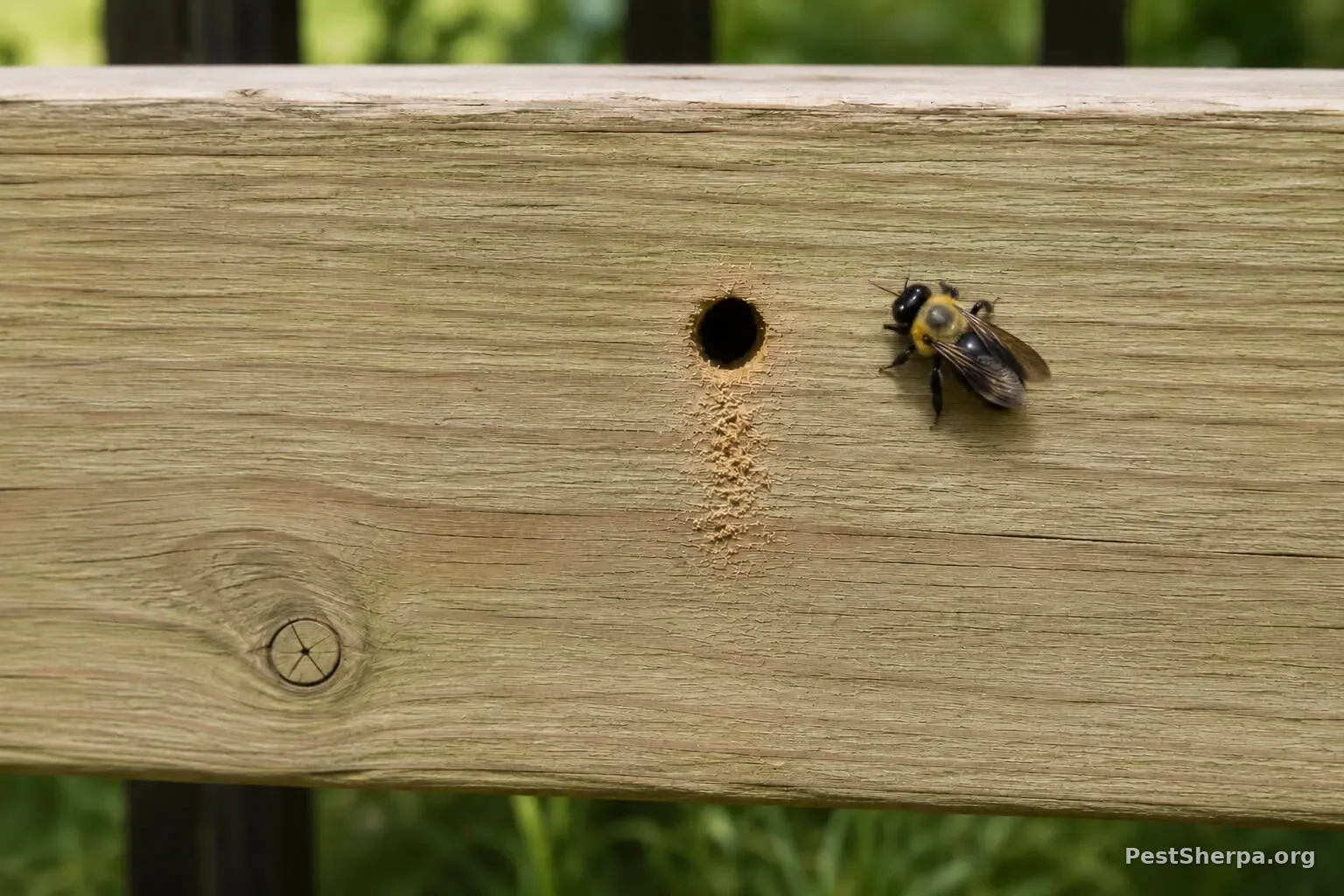
Carpenter bees are large, solitary bees that excavate neat, round tunnels in unfinished or weathered softwoods. Females provision galleries with pollen for larvae. Males may hover aggressively near decks but cannot sting. The wood damage is real over years of reuse and expansion of old tunnels, even though a single season’s galleries are often shallow.
Traps usually use a wooden block with a drilled hole leading into a clear jar or bottle. Bees investigating nest sites may enter and become trapped. Success depends on placement near existing galleries, trap design, and whether new wood still invites nesting.
What works with traps
- Hang or mount traps near known activity on the sunny side of decks, eaves, and railings.
- Empty and maintain traps so captured bees do not rot and repel others.
- Fill and seal old galleries after activity drops (often late season), using wood filler or dowels, then paint or varnish unfinished wood.
- Paint, stain, or finish exposed softwood. Finished wood is far less attractive.
- Avoid broadcasting insecticide on blooming plants where pollinators forage.
Limits and safety notes
Killing every bee you see is not the goal. Carpenter bees are pollinators. Focus on protecting the structure. Dusts labeled for carpenter bees in galleries can help when used carefully by someone who reads the label, but leftover untreated wood invites return visits next spring.
When to bring in help
Extensive tunneling in structural members, repeated yearly damage, or nests high on a multi-story fascia may need a licensed technician plus a carpenter for repairs. Ask for a plan that includes exclusion and finish work, not only a spray pass.
Timing traps with the season
Spring and early summer are when females seek nesting sites. Traps placed then, near last year’s holes, catch more than traps hung randomly in midwinter. Still paint and seal afterward. A full jar with unfinished fascia left bare is a half solution.
Paint is prevention
Fresh paint or solid stain on fascia and rails after repairs is one of the highest-value steps homeowners skip. Bare weathered wood invites next year’s generation even if this year’s traps worked.
Related guides
References
- Penn State Extension: Carpenter Bees
- Clemson HGIC: Carpenter Bees
- University of Kentucky: Carpenter Bees
This article was written by Greg Baumann, founder of Pest Sherpa, and reflects more than 40 years of professional pest management experience.
About the Author

Greg Baumann | Pest Control Expert
Greg Baumann is the founder of Pest Sherpa and a Pest Control Expert with more than 40 years of professional pest management experience. His articles combine decades of field experience, technical expertise, and science-based guidance to help homeowners identify pests correctly, understand real-world risks, and make informed pest management decisions.
Mission: Identify the pest. Understand the risk. Stop the problem. Prevent the comeback. Know when it’s time to call a professional.