
Slugs: Identification, Slime Trails, Plant Damage, and What To Do
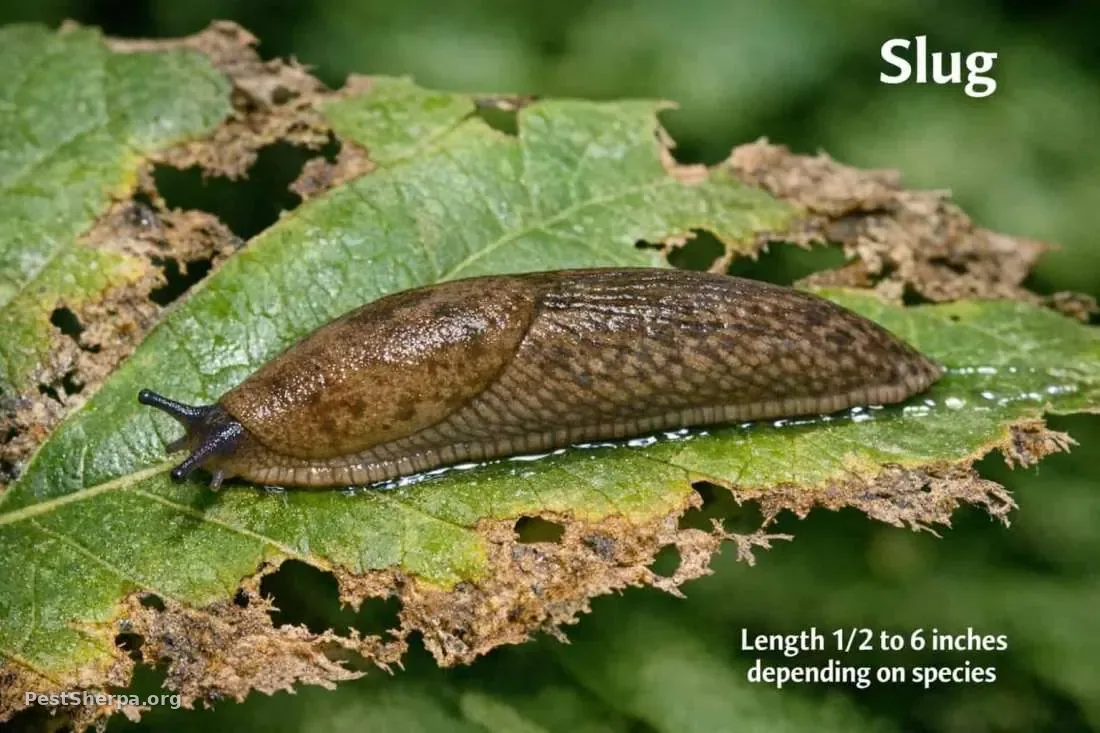
Slugs are soft-bodied, moisture-loving mollusks that usually become a problem where damp shelter, mulch, dense vegetation, irrigation, or drainage issues give them places to hide. Outdoors, they can chew ragged holes in seedlings, vegetables, flowers, fruit, and ornamental plants. Indoors, they are usually a clue that moisture and entry points need attention rather than a sign of a structural infestation.
This guide explains how to identify slugs, what their slime trails and plant damage mean, why they sometimes show up in basements or garages, and what practical steps can reduce activity without overusing pesticides.
TL;DR
Slugs are not insects. They are shell-less terrestrial mollusks related to snails. One slug indoors is rare unless there is excessive moisture on the travel surface and may simply have entered through a gap, but repeated sightings usually point to damp or even wet conditions, nearby shelter, or an outdoor population close to the structure. The most useful control steps are reducing moisture, removing daytime hiding places, inspecting at night or early morning, protecting vulnerable plants, and sealing easy entry points. Slugs are not general considered dangerous but slugs can serve as intermediate hosts for rat lungworm parasites in some regions.
Pesticide baits are not always necessary and do not provide long-term control by themselves. If a bait is used, follow the label exactly and use extra caution around children, pets, edible plants, wildlife, and water.
Quick Navigation
- Identification
- Quick ID Table
- Signs and Damage
- Why Slugs Show Up Indoors
- Conditions That Favor Slugs
- Inspection Checklist
- What To Do
- What Doesn’t Work Well
- How Long Slug Problems Last
- Control Options and Safety Notes
- When Professional Help May Be Worth Considering
- Lookalikes
- Frequently Asked Questions
- References
Identification: What Slugs Look Like
Slugs are terrestrial gastropod mollusks. Unlike most snails, they do not have a visible coiled shell, although some species may have a small internal shell remnant. Their bodies are soft, elongated, and moist, and they move by gliding on a muscular foot that produces mucus.
Most household and garden slugs are gray, brown, black, yellowish, or mottled. Size varies by species and age, from small juveniles under an inch long to large adult slugs several inches long. Because slug species can be difficult to confirm from color alone, homeowners should focus first on the signs, habitat, and damage pattern.
Helpful identification features include:
- Soft, shell-less body
- Moist or shiny surface
- Four tentacles on the head area, with the upper pair bearing eyes and lower pair being sensory tentacles
- A raised mantle behind the head
- Silvery slime trails on soil, mulch, patios, walls, floors, or plant surfaces
- Activity mostly at night, early morning, or during damp cloudy weather
Common pest species vary by region. Examples include the gray garden slug or gray field slug (Deroceras reticulatum), the great gray slug or leopard slug (Limax maximus), and the marsh slug (Deroceras laeve). Species-level identification may require close examination and is not always necessary for basic homeowner decisions.
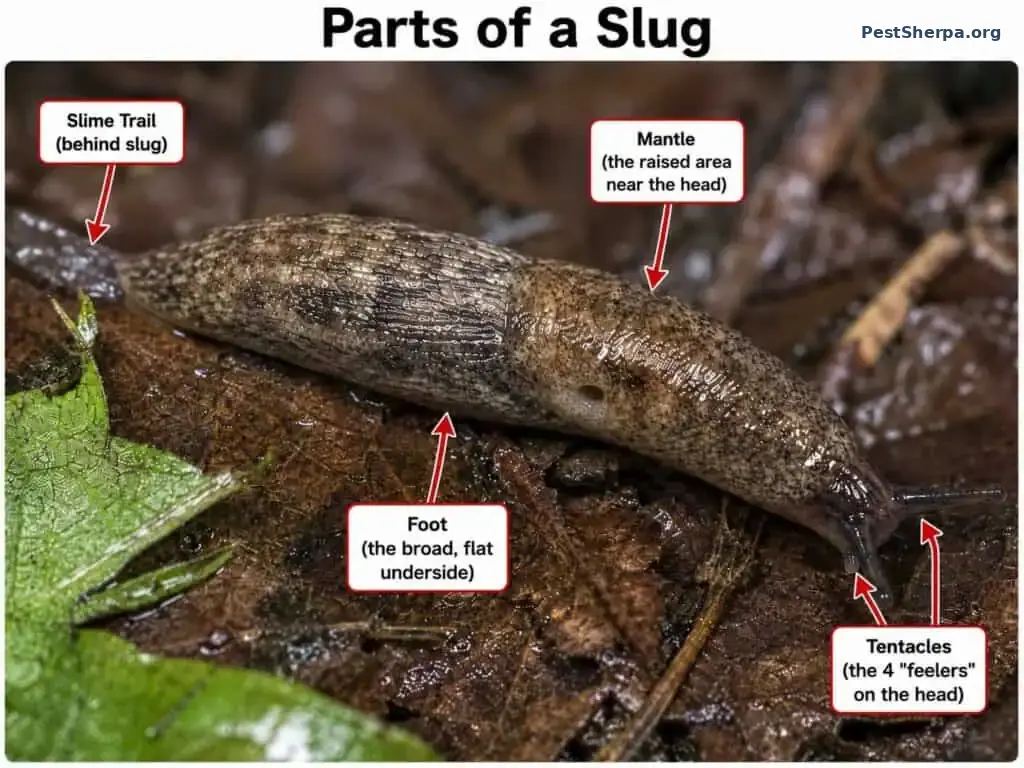
Labeled slug anatomy showing tentacles, mantle, foot, and slime trail.
Quick ID Table
| Feature | Slug Clue | What It Means |
|---|---|---|
| Body | Soft, moist, elongated, no obvious shell | Likely slug rather than snail or insect larva |
| Trail | Shiny silver mucus trail | Strong sign of recent slug or snail movement |
| Damage | Ragged holes in leaves, flowers, fruit, or seedlings | Possible slug feeding, especially with slime trails nearby |
| Timing | Mostly seen at night or after rain | Matches slug moisture needs |
| Indoor sighting | Slug on basement, garage, crawlspace, or utility-room floor | Often points to dampness and an entry gap |
Signs and Damage
The most recognizable sign is a shiny slime trail. These trails may appear on soil, mulch, concrete, foundation edges, patio surfaces, exterior walls, garage floors, basement floors, or lower plant leaves.
Plant damage usually appears as irregular, ragged chewing. Slugs can feed on seedlings, tender leaves, flowers, ripening fruit, vegetables, and decaying plant material. Seedlings and young plants are often most vulnerable because a small amount of feeding can remove much of the plant.
Slug damage is more likely when plant injury appears overnight and slime trails are present. If there are no slime trails, inspect carefully for caterpillars, earwigs, beetles, or other chewing pests before assuming slugs are responsible.
Why Slugs Show Up Indoors
Slugs found indoors usually entered from outside or moved in from a damp structural area. They do not chew wood, damage wiring, or infest homes the way some insects can. Indoor sightings usually mean there is enough moisture nearby for them to survive.
Common indoor locations include:
- Basements
- Crawl spaces
- Garages
- Laundry rooms
- Utility rooms
- Areas near exterior doors, pipe penetrations, floor drains, or foundation gaps
One slug indoors may be a minor accidental invader. Repeated sightings, slime trails in the same area, or slugs appearing after rain should prompt a moisture and entry-point inspection.
Conditions That Favor Slugs
Slugs need moisture and shelter. Problems are most common where landscaping, irrigation, drainage, and shade create damp daytime hiding places.
| Condition | Why It Matters | What To Check |
|---|---|---|
| Heavy mulch | Holds moisture and provides daytime shelter | Deep mulch near seedlings, foundations, and damp beds |
| Dense ground cover | Creates shade and humid hiding spaces | Ivy, thick plantings, weeds, and low vegetation near walls |
| Frequent irrigation | Keeps soil and leaves damp | Overhead watering, evening watering, overspray against the foundation |
| Poor drainage | Leaves soil persistently wet | Low spots, clogged gutters, downspouts, grading problems |
| Debris and stored materials | Creates protected harborages | Boards, pots, stones, tarps, leaf litter, firewood, and clutter |
| Structural moisture | Allows indoor survival | Leaks, condensation, damp crawl spaces, wet garage edges, utility penetrations |
Slugs often overlap with other moisture-associated pests. If the animals are tiny and jumping, review springtails. If they are armored, segmented, and found under damp objects, compare sowbugs and pillbugs.
Slug Inspection Checklist
Slug inspection works best after dark, early in the morning, after rain, or on damp cloudy days. Use a flashlight and follow slime trails back toward shelter.
Outdoors
- Look under boards, pots, pavers, stones, tarps, edging, and low planters.
- Inspect mulch beds, leaf litter, compost edges, and dense ground cover.
- Check vulnerable plants for fresh ragged chewing and slime trails.
- Inspect along foundation edges, door thresholds, garage doors, and patio transitions.
- Check irrigation overspray, downspout discharge, clogged gutters, and low drainage areas.
Indoors
- Follow slime trails toward exterior doors, cracks, drains, utility penetrations, or damp wall edges.
- Inspect basements, crawl spaces, garages, laundry rooms, and utility rooms.
- Look for condensation, plumbing leaks, damp stored materials, or water intrusion.
- Check door sweeps, weather stripping, garage-door seals, foundation gaps, and pipe openings.
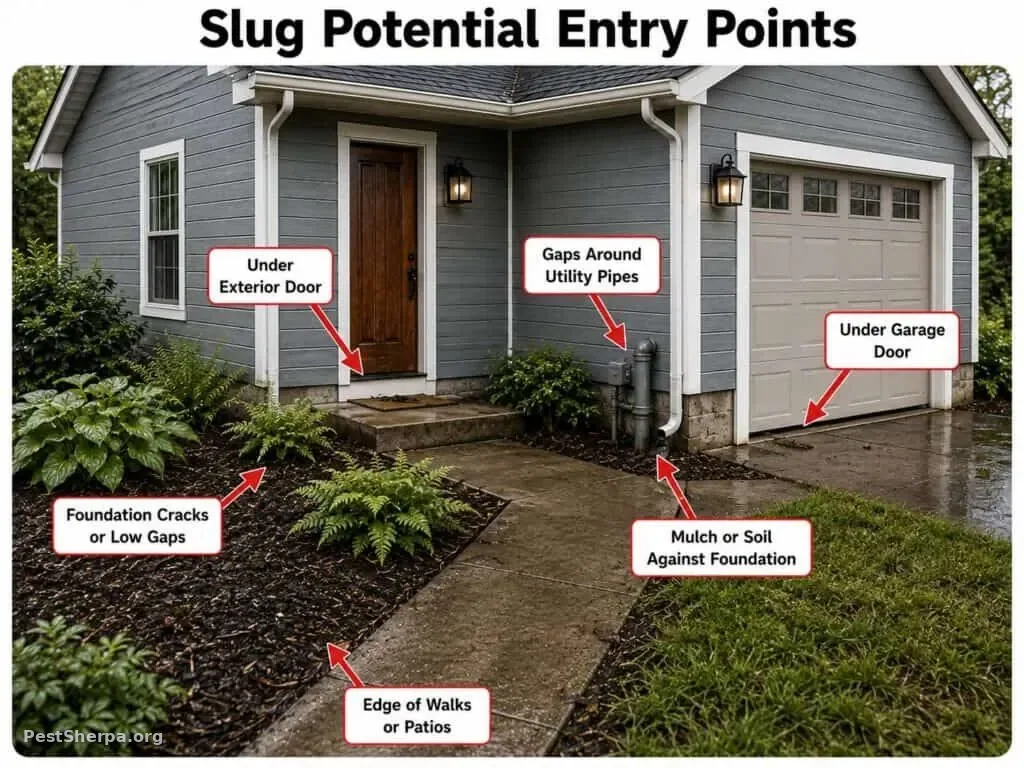
Common slug entry and moisture points around a home foundation.
What To Do About Slugs
1. Confirm the pest
Look for a soft, shell-less body and a shiny slime trail. If the animal has a shell, compare it with small household snails. If it has many hard body segments and curls or rolls up, compare millipedes or pillbugs.
2. Reduce moisture
Water in the morning instead of evening when practical. Avoid keeping leaves, mulch, and soil wet overnight. Correct irrigation overspray, drainage problems, leaking hose bibs, clogged gutters, and damp crawlspace or basement conditions.
3. Remove daytime hiding places
Thin dense vegetation, pull excessively wet mulch back from the foundation, remove extra leaf litter, and reduce clutter such as boards, pots, pavers, tarps, and unused landscape materials where slugs hide during the day.
4. Trap and remove slugs where activity is concentrated
Small boards, shingles, or overturned pots can be used as shelter traps. Place them near damage areas, check them in the morning, and remove the slugs found underneath. This works best when combined with moisture and habitat correction.
5. Protect vulnerable plants
Focus protection on seedlings, tender transplants, ripening fruit, and heavily damaged plants. Raising pots, improving airflow, thinning plantings, and keeping mulch away from tender stems can reduce feeding pressure.
6. Improve exclusion
For indoor sightings, repair door sweeps, garage-door seals, weather stripping, foundation gaps, pipe penetrations, and low openings where slugs may enter from damp exterior areas.
What Doesn’t Work Well
- Only spraying visible slugs: This misses the moisture and shelter conditions that allowed the problem.
- Relying only on baits: Baits may reduce feeding, but long-term control still depends on shelter and moisture reduction.
- Using salt in garden beds: Salt can harm soil and plants and is not a good landscape-management tool.
- Ignoring irrigation: Evening watering and wet mulch can keep slug habitat favorable even after slugs are removed.
- Assuming every indoor sighting is an infestation: A single slug may be an accidental invader, but repeated sightings should trigger a moisture and entry-point inspection.
How Long Do Slug Problems Last?
Slug activity changes with moisture, temperature, shelter, and season. Problems may decline quickly when a small source of moisture is corrected, but outdoor populations can persist when heavy mulch, dense vegetation, damp soil, and frequent irrigation remain in place.
| Situation | Likely Pattern | Best Next Step |
|---|---|---|
| One slug indoors | May be accidental entry | Remove it and inspect nearby entry points |
| Repeated indoor slime trails | Moisture or entry gap likely | Trace trails and inspect exterior side of the wall or door |
| Seedlings damaged overnight | Active feeding nearby | Inspect after dark and reduce hiding places |
| Damage after rain or irrigation | Moisture-driven activity | Adjust watering and improve drainage |
| Recurring garden damage each season | Favorable habitat remains | Combine habitat reduction, monitoring, barriers, and targeted removal |
Control Options and Safety Notes
Slug control works best as a combined approach. Start with moisture management, shelter reduction, monitoring, hand removal, and exclusion. These steps reduce the conditions that allow slugs to survive and reproduce.
If slug or snail bait is considered, use only products labeled for the site and pest. Read and follow the entire label. Keep baits away from children, pets, livestock, wildlife, food-preparation areas, drains, and water. Do not pile bait, do not apply more than the label allows, and do not assume a product is safe simply because it is sold for home and garden use.
Some slug bait active ingredients have greater pet-risk concerns than others. Products containing metaldehyde require especially careful handling because accidental ingestion can be dangerous to dogs and other animals. Iron phosphate, ferric sodium EDTA products and borate baits are often mentioned as lower-toxicity alternatives, but they still require label-compliant use and pet precautions. Never assume that lower toxicity means that it cannot be harmful if the label is not strictly followed.
For edible gardens, greenhouses, schools, childcare areas, pet yards, or sites near ponds and waterways, be conservative. Nonchemical steps and label-compliant risk reduction should come first.
When Professional Help May Be Worth Considering
Many slug problems can be reduced with inspection, drying, habitat changes, and hand removal. Professional help may be worth considering when the cause is not obvious, when slugs keep appearing indoors, or when the site has moisture problems that are difficult to correct.
- Slugs repeatedly appear inside a basement, crawl space, garage, or commercial building.
- There are persistent slime trails but the entry point is unclear.
- Drainage, crawlspace humidity, or water intrusion may be involved.
- Large greenhouse, nursery, food garden, or sensitive-site damage is occurring.
- Pets, children, livestock, edible plants, or water features make bait choices more complicated.
- The pest may be a lookalike and identification is uncertain.
Similar Pests and Common Misidentifications
| Lookalike | How It Differs From a Slug | Why It Matters |
|---|---|---|
| Small household snails | Have an external shell | Similar moisture needs, but easier to separate visually |
| Springtails | Tiny, insect-like, often jump when disturbed | Usually points to moisture, mold, or damp organic material |
| Sowbugs | Segmented, armored body; do not produce slug slime trails | Moisture-associated occasional invaders |
| Pillbugs | Segmented and can roll into a ball | Often found under damp objects outdoors |
| Millipedes | Many legs and hard body segments | May invade after wet weather but are not slugs |
| Earthworms | No tentacles, no mantle, different movement and body structure | Usually beneficial soil animals, not plant-chewing slugs |
| Caterpillars or insect larvae | May have legs, a distinct head capsule, or no slime trail | Plant damage may require a different diagnosis |
Frequently Asked Questions
Are slugs insects?
No. Slugs are mollusks, not insects. They are related to snails but usually lack an obvious external shell.
Do slugs bite people?
Slugs do not bite or sting people in the way insects or spiders might. The main concerns are plant damage, nuisance slime trails, and the damp conditions that allow them to survive indoors.
Why do I keep finding slugs in my basement or garage?
Repeated indoor sightings usually mean slugs are entering from a damp exterior area or surviving near a moisture source. Check door seals, foundation gaps, pipe penetrations, garage edges, crawl spaces, and nearby mulch or vegetation.
Do slime trails always mean slugs?
Slime trails are strong evidence of slugs or snails. If a shell is present, the pest is a snail. If there is no obvious shell and the body is soft and elongated, a slug is likely.
Will slug bait solve the problem?
Not by itself in most cases. Baits may reduce feeding when used correctly, but long-term improvement depends on moisture reduction, shelter removal, monitoring, and exclusion.
Is metaldehyde slug bait safe around dogs?
Metaldehyde slug and snail baits can be dangerous to dogs if ingested. Avoid using any bait where pets, children, livestock, or wildlife may access it, and always follow label directions and storage precautions.
Should I pour salt on slugs?
Salt is not a good garden or structural management tool. It can affect soil and plants and does not solve the moisture and shelter conditions that caused the activity.
References
- UC Statewide IPM Program: Snails and Slugs
- Oregon State University Extension Service: How to Control Slugs in Your Garden
- Oregon State University College of Agricultural Sciences: Slug Portal: Common Species
- University of Minnesota Extension: Slugs in Home Gardens
- Penn State Extension: Slugs and Their Control
- National Pesticide Information Center: Could Snail Bait Hurt My Dog?
This article was written by Greg Baumann, founder of Pest Sherpa, and reflects more than 40 years of professional pest management experience.
About the Author

Greg Baumann | Pest Control Expert
Greg Baumann is the founder of Pest Sherpa and a Pest Control Expert with more than 40 years of professional pest management experience. His articles combine decades of field experience, technical expertise, and science-based guidance to help homeowners identify pests correctly, understand real-world risks, and make informed pest management decisions.
Mission: Identify the pest. Understand the risk. Stop the problem. Prevent the comeback. Know when it’s time to call a professional.