
Common House Spider: Identification, Webs, and How to Control Them
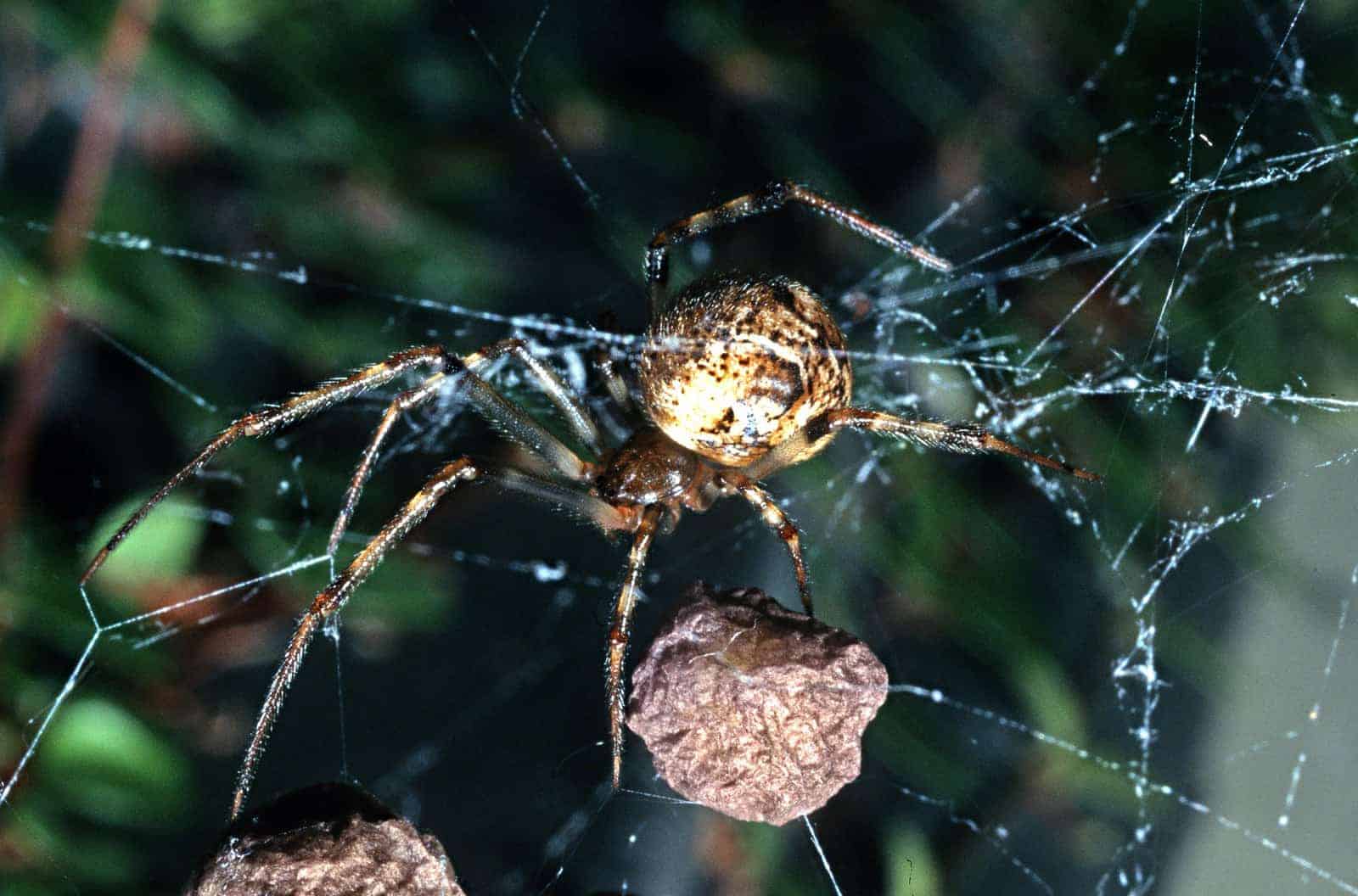
If you find a tangle of cobwebs in the corner of a basement window, behind the washer, or near the ceiling, the common house spider, also called the American house spider, may be responsible. It is one of the most widespread spiders in the world and is frequently encountered in North American homes.
Common house spiders are not considered medically important, but they can create numerous messy webs. Because several spider species build similar cobwebs, finding the spider or its characteristic egg sacs is more reliable for identification than the web alone.
This guide explains how to identify the common house spider, distinguish it from black widows and other look-alikes, and reduce webs and spiders through cleaning, exclusion, and other practical measures without unnecessary insecticide applications.
Key Points
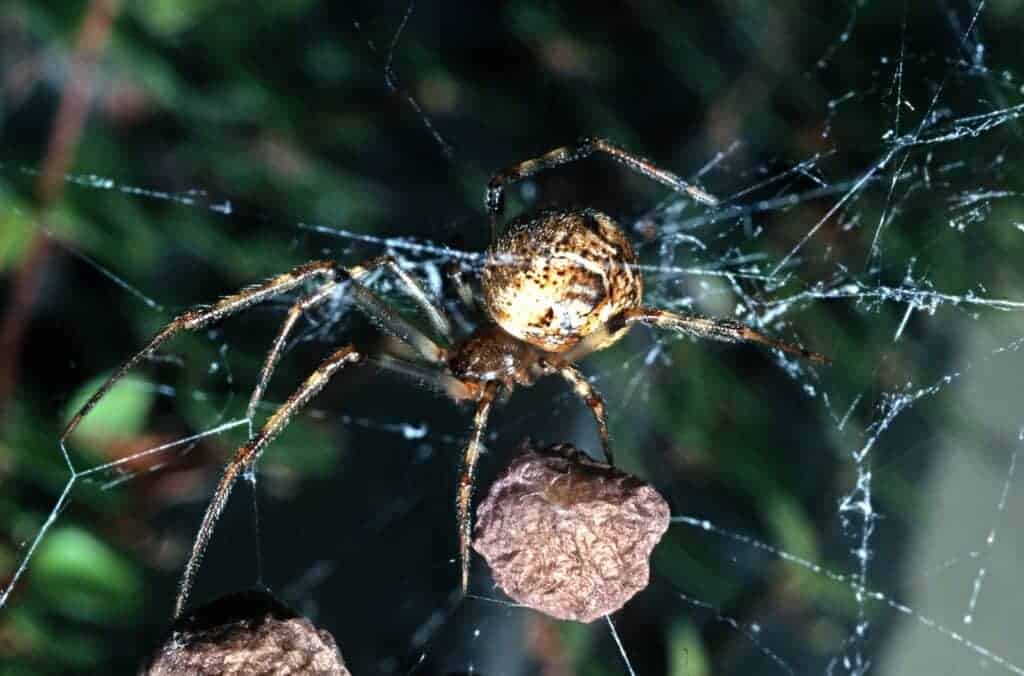
The common house spider (Parasteatoda tepidariorum) is a small, widely distributed cobweb spider. Adult females are approximately 1/5 to 1/4 inch (5 to 6 mm) long, with a yellowish-brown front body and a rounded abdomen ranging from dirty white to brown, often marked with darker gray or brown chevrons. Their yellowish legs commonly have darker bands.
Common house spiders are not considered medically important and rarely bite people. They are primarily nuisance pests because their irregular webs accumulate in corners, around windows, and in other protected locations. They may abandon old webs and construct new ones nearby, allowing cobwebs to accumulate even when relatively few spiders are present.
Control begins with cleaning and removing webs and egg sacs. Vacuuming, reducing clutter, sealing entry points, and limiting the insects that spiders feed on are generally more useful than routine spraying. Insecticides may provide temporary control in certain situations, but they should supplement rather than replace housekeeping and exclusion.
In This Guide
- How to Identify a Common House Spider
- House Spider vs Black Widow and Other Look-Alikes
- Life Cycle and Egg Sacs
- Where You Find Them
- Do They Bite?
- How to Get Rid of House Spiders
- What Does Not Work
- Prevention
- What a Pro Visit Looks Like
- What It Costs
- Common Questions
- References
How to identify a common house spider
| Feature | Female | Male |
|---|---|---|
| Body length | Approximately 1/5 to 1/4 inch (5 to 6 mm) | Approximately 3.8 to 4.7 mm (about 3/16 inch) |
| Front body (carapace) | Yellowish-brown | Generally yellowish-brown to brown |
| Abdomen | Rounded, dirty white to brown, with darker gray or brown chevron-like markings; some have a dark triangular marking | Smaller and usually less rounded than the female’s abdomen, with variable mottled markings |
| Legs | Slender, yellowish, often with darker bands near the joints | Slender, often more orange-brown, with variable darker markings |
The common house spider belongs to the cobweb spider family, Theridiidae. Its rounded abdomen, slender legs, and irregular three-dimensional web are characteristic of this group.
Like other spiders, adults have eight legs and two principal body regions. The abdomen is attached to the front body, or cephalothorax, by a narrow connection.
Common house spiders build irregular, sticky webs rather than the organized circular webs associated with orb-weaving spiders. They often hang upside down in their webs while waiting for prey.
Color and size vary between individuals, so identification should consider several features rather than relying on a single marking.
House spider vs black widow and other look-alikes
The common house spider and black widow belong to the same spider family and share some characteristics, including rounded abdomens and irregular cobwebs.
However, they differ in appearance, habits, and medical significance. Identifying the actual spider is important because cobwebs alone may not distinguish the species.
| Spider | Color and markings | Web and habits |
|---|---|---|
| Common house spider | Mottled tan, brown, gray, or dirty white; yellowish legs often have darker bands | Irregular, tangled cobwebs in corners, around windows, beneath joists, and in other protected locations indoors or outdoors |
| Adult female black widow | Usually shiny black with a red or orange hourglass-shaped marking on the underside of the abdomen | Strong, irregular cobwebs in sheltered, relatively undisturbed locations, including garages, sheds, woodpiles, and outdoor structures |
| Cellar spiders | Small, pale bodies with extremely long, slender legs | Loose, irregular webs in basements, garages, crawl spaces, and ceiling corners; generally not considered medically important |
| Yellow sac spider | Usually pale yellow, cream, or greenish, sometimes with a slightly darker front body | Primarily hunts at night rather than capturing prey in a cobweb; rests in small silken retreats along walls, ceilings, or other protected surfaces |
An important identification caution is that immature black widows may be brownish or patterned with lighter markings. Not every widow resembles the familiar glossy black adult female.
Likewise, not every brown spider with a rounded abdomen is a common house spider.
Cellar spiders are generally harmless to people, but the popular claim that their fangs are universally too short to penetrate human skin is unreliable, and so is the daddy long-legs myth.
Yellow sac spiders differ from common house spiders because they are active hunters and do not depend on large prey-catching cobwebs. They may bite if trapped against the skin, although most bites are not medically serious.
When identification is uncertain, avoid handling the spider directly and obtain a clear photograph for comparison with reliable identification resources.
Life cycle and egg sacs
Common house spiders may be found as adults throughout the year, especially inside heated buildings and other protected locations. Adults can live a year or more after reaching maturity.
Males and females may occupy the same web and mate repeatedly.
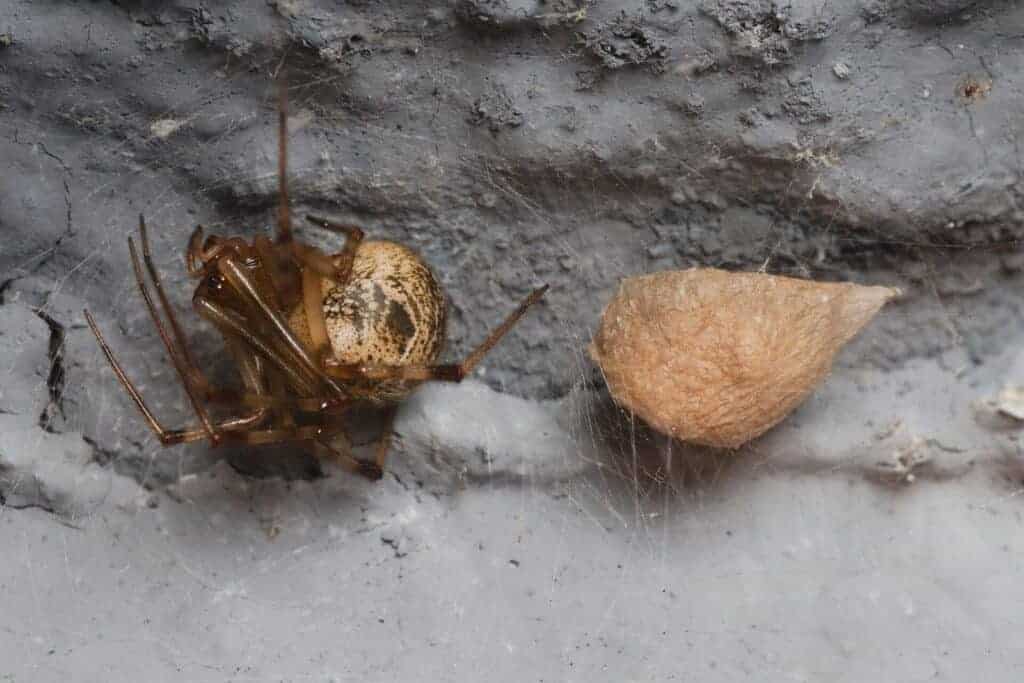
Females produce distinctive egg sacs that are brown, oval to somewhat pear-shaped, and covered with a tough, papery outer layer. The sacs are typically about 1/4 to 3/8 inch (6 to 9 mm) across and are suspended within the web.
A female may produce twelve or more egg sacs during her lifetime. Penn State Extension reports that individual sacs may contain approximately 140 to 380 eggs.
These figures describe the species’ reproductive potential. The number of sacs produced and the number of spiderlings surviving depend on conditions, including food availability, temperature, and predation.
Newly emerged spiderlings may remain near the egg sac briefly before dispersing to establish their own webs.
Removing accessible egg sacs is useful because it prevents the enclosed eggs from developing into additional spiders.
Where you find them
Common house spiders occupy sheltered locations that provide suitable web-attachment points and access to insect prey.
Indoors, they frequently build webs in corners, around windows, beneath floor joists, behind appliances, and in basements, garages, crawl spaces, and other relatively undisturbed areas.
They may be common in damp basements, but moisture alone does not determine where they live. Shelter, protected web sites, and a dependable supply of insects are important factors.
Outdoors, common house spiders occur around buildings, beneath bridges, under rocks and boards, and in barns, sheds, and other structures.
Webs often accumulate near windows and outdoor lighting because insects gather in those locations. Spiders that successfully capture prey may remain in a favorable site for extended periods.
Old webs may remain after a spider has moved or died, so the number of visible cobwebs does not necessarily indicate the number of living spiders.
Do they bite?
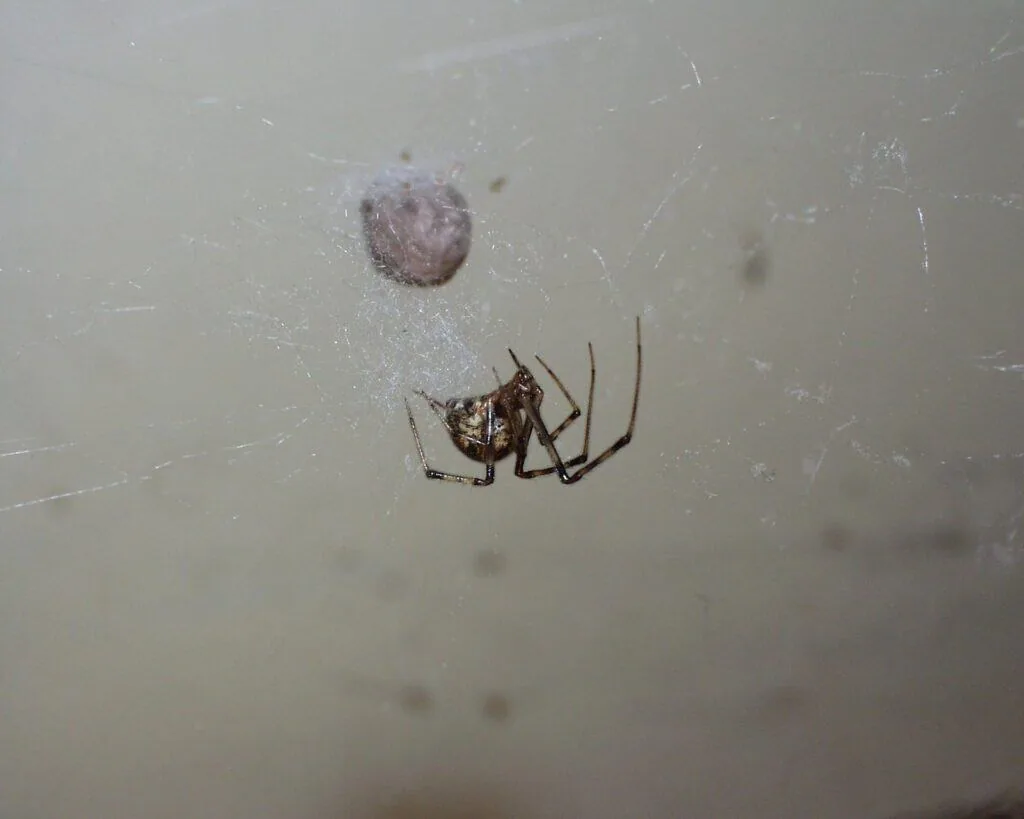
Common house spiders rarely bite people and are not considered medically important.
Their venom is used to subdue insect prey, but the species is not associated with the serious medical effects sometimes caused by black widow or recluse spider bites.
Penn State Extension describes a small number of verified bites that produced localized redness and pain. In reported cases, discomfort increased during approximately the first hour and persisted for several hours, sometimes as long as 24 hours.
Because bites are uncommon, individual reactions may vary.
Spiders generally bite defensively when trapped against skin, squeezed, or otherwise disturbed. They do not seek people as a food source.
If a suspected bite causes increasing pain, extensive swelling, spreading redness, blistering, or symptoms beyond the bite site, seek medical advice. Severe allergic symptoms, such as difficulty breathing, require emergency care.
Many skin lesions attributed to spiders are actually caused by other insects, infections, or unrelated skin conditions. A suspected spider bite should not be considered confirmed unless a spider was observed biting or other convincing evidence is available.
If practical, save the spider or obtain a clear photograph for identification without risking another bite.
Our spider guide covers other species, including those of greater medical concern.
How to get rid of house spiders
Remove webs, spiders, and egg sacs. Vacuuming is one of the simplest and most effective methods for reducing common house spider activity. Use a hose attachment to reach corners, window frames, floor joists, and other web sites. A broom or long-handled web brush can also remove webs.
Discard vacuum contents promptly when they contain spiders or egg sacs. Removing egg sacs prevents the enclosed young from hatching.
Reduce clutter. Organize basements, garages, closets, storage rooms, and attics. Removing unnecessary boxes and stored materials reduces protected web-building locations and makes cleaning easier.
Clean building exteriors. Remove webs from eaves, window frames, siding, and other reachable surfaces with a broom, brush, or water spray appropriate for the surface. Avoid forcing water into siding, electrical fixtures, or wall openings.
Use sticky traps selectively. Small glue boards or sticky monitoring traps placed along walls and in corners may capture wandering spiders and reveal areas of activity. However, they are less useful for spiders that remain in established webs. Position traps where children, pets, and wildlife cannot contact them, and inspect them regularly.
Correct moisture problems when present. Repair plumbing leaks and address excessive basement or crawl-space moisture. Dehumidification may improve building conditions and reduce some moisture-associated insects that provide food for spiders.
Use insecticides only when justified. Routine indoor spraying is generally unnecessary for common house spiders. Contact sprays may kill exposed spiders but often provide temporary relief because they do not remove webs, egg sacs, or conditions supporting spider activity.
Where a substantial problem persists, appropriately labeled targeted treatments may supplement inspection, cleaning, and exclusion.
What does not work
Bug bombs and indoor fogging: Total-release foggers are generally a poor choice for common house spiders. Pesticide mist may not adequately reach spiders sheltered in cracks, protected corners, or other concealed locations. Foggers also introduce unnecessary pesticide residues and potential exposure risks.
Spraying open floors and walls: Broad applications to exposed indoor surfaces are generally unnecessary and may not contact spiders in their webs or protected sites. They also fail to correct the conditions that allow spiders to persist.
Plug-in ultrasonic devices: Ultrasonic pest repellents have not demonstrated dependable, lasting control of household spiders. See our answer on whether ultrasonic repellents work.
Conkers, chestnuts, and home remedies: Claims that horse chestnuts or other household materials reliably repel spiders are not supported by convincing scientific evidence. See do conkers keep spiders away and does peppermint oil keep spiders away.
Prevention
Seal entry points. Repair cracks and openings around foundations, windows, doors, plumbing, vents, and utility penetrations. This helps reduce the movement of spiders and the insects they feed on.
Maintain screens and door sweeps. Repair damaged window screens, install appropriate weatherstripping, and make sure exterior doors close tightly.
Reduce exterior hiding places. Move stacked firewood, unused materials, and debris away from the foundation. Trim shrubs, vines, and branches that touch the house to reduce protected areas and direct access routes.
Adjust outdoor lighting. Outdoor lights attract night-flying insects that may become spider prey. Consider warm yellow or other insect-reducing lighting, motion-activated fixtures, or positioning lights away from doors and windows. Lighting changes can reduce insect attraction but will not eliminate every spider.
Improve storage. Use closed storage containers when practical instead of leaving items scattered or stored in open cardboard boxes. Keeping stored materials organized reduces protected hiding spaces and makes inspection and cleaning easier.
Clean regularly. Vacuum basement corners, window frames, exposed joists, garage areas, and spaces behind appliances. Remove new webs and egg sacs before they accumulate.
What a pro visit looks like
Most common house spider problems can be handled without professional pesticide applications.
When professional assistance is needed, a good service should begin with identifying the spider, locating active web sites, and examining conditions that allow spiders to remain around the building.
The objective is to reduce nuisance activity through inspection, cleaning, exclusion, and selective treatment when necessary, rather than automatically spraying the entire structure.
The inspection
The technician should confirm the species and inspect areas where spiders or webs have been reported.
Typical inspection locations include garages, basements, crawl spaces, closets, window wells, eaves, exterior foundation areas, woodpiles, and stored materials.
The inspection should evaluate active web locations, nearby insect activity, entry points, lighting, clutter, and moisture conditions.
Sticky monitoring traps may help document wandering spider activity, but direct examination of webs is often more useful for identifying an established common house spider population.
Your prep before the visit
- Move stored boxes, firewood, and unnecessary debris away from the foundation where practical.
- Clear access to the garage perimeter, basement walls, crawl-space entrance, and other areas requiring inspection.
- Follow the company’s instructions for protecting pets, food, and water dishes if pesticide treatment is planned.
- Identify locations where you regularly find spiders, fresh webs, and egg sacs.
- Tell the technician about previous pesticide treatments or other control methods.
The treatment
A professional control program may include:
- Removal of accessible spiders, webs, and egg sacs with a vacuum or web brush.
- Recommendations for reducing clutter, insect prey, and favorable web-building locations.
- Exclusion measures such as repairing screens, installing door sweeps, and sealing gaps.
- Adjustments to outdoor lighting and vegetation near the building.
- When necessary, appropriately labeled targeted insecticide applications to specific entry points, cracks, crevices, or other permitted locations.
A residual perimeter treatment may be appropriate in selected circumstances to limit the food of the spiders, but routine blanket spraying should not be the default recommendation for common house spiders.
Indoor pesticide treatments should be limited to locations and application methods permitted by the product label.
Follow-up
Follow-up depends on the extent of spider activity and the control measures used.
For many common house spider problems, regular cleaning and correcting entry points are sufficient without recurring pesticide applications.
If a company recommends repeat treatments, ask what ongoing activity justifies them and how effectiveness will be evaluated.
Continue removing new webs, reducing clutter, and correcting conditions that attract insects between professional visits.
Questions to ask before you book
- What spider species did you identify, and is it medically important?
- What pesticide product, if any, will you use, and where will it be applied?
- Is indoor treatment necessary, or can the problem be managed through cleaning and exclusion?
- What entry points, lighting conditions, or other factors should I correct?
- Is this a one-time service or an ongoing contract, and what are the cancellation terms?
See how to hire a licensed pest control company for licensing, contracts, and other service-selection considerations.
What it costs
Professional common house spider control is generally priced similarly to routine pest-control services.
The cost depends on property size, the amount of spider activity, accessibility, and whether the service includes web removal, inspection, exclusion recommendations, or pesticide applications.
For pricing comparisons between one-time services and recurring plans, see what spider control costs in our national cost guide.
Typical national ranges
Published consumer pricing estimates include:
- Spider extermination: $100 to $500 (Angi, 2026).
- General pest-control service: A national average around $172, with a broad published range of $50 to $500 (Angi, 2026).
- One-time spider treatment: $100 to $300 (HomeGuide, 2026).
- One-time exterminator visit across pest categories: $100 to $600 (HomeGuide, 2026).
- Annual general pest-control plan: $300 to $900 (HomeGuide, 2026).
- Quarterly general pest-control visit: Approximately $100 to $300 per visit (HomeGuide, 2026).
These are national consumer estimates based on data reported, not guaranteed prices for common house spider control.
A minor spider problem resolved through cleaning may require no professional service at all. More extensive inspections, exclusion repairs, or repeated treatments can increase the total cost.
Compare written estimates to determine exactly what services are included.
What moves the price
- The size of the home and the extent of the areas requiring inspection or treatment.
- Clutter, stored materials, woodpiles, or vegetation near the building.
- Whether garages, crawl spaces, sheds, and other outbuildings are included.
- Whether the spider is medically important or requires specialized management.
- The need for exclusion repairs, extensive web removal, or additional visits.
- Whether service is provided as a one-time treatment or part of a recurring plan.
One-time job or ongoing plan
Most homeowners dealing with common house spiders do not need a recurring pesticide service.
Regular vacuuming, egg sac removal, exclusion, and reducing insect prey are generally enough to keep nuisance activity manageable.
A one-time professional inspection or targeted treatment may be useful when spiders are numerous or difficult to access.
Recurring service may be justified for persistent problems or when a property has ongoing activity from multiple pests, but living near woods or water does not automatically make a spider-control contract necessary.
Red flags in a quote
- Proposing indoor fogging or widespread spraying of occupied rooms without a clear reason.
- Offering treatment without identifying the spider species.
- Recommending an extended contract without explaining the service need or cancellation terms.
- Promising that one pesticide application will permanently eliminate spiders.
- Ignoring web removal, egg sacs, entry points, and other contributing conditions.
Ask for written documentation of the spider species, proposed treatment areas, pesticide products, number of visits, and any warranty or follow-up terms.
Common questions about common house spiders
Is the common house spider poisonous?
The common house spider is venomous, as are most spiders, but it is not considered medically important to people. The venom is used to subdue prey rather than for attacking humans.
Verified bites are rare. Reported reactions have generally involved localized redness and discomfort lasting several hours, sometimes up to about 24 hours.
Is a common house spider a baby black widow?
No. The common house spider and black widow are separate types within the same cobweb spider family.
The common house spider is generally mottled brown, tan, or gray with slender, often banded legs. Adult female black widows are typically shiny black with a red or orange hourglass-shaped marking on the underside.
However, young black widows can be brown or patterned, so color alone should not be used to identify an unfamiliar spider.
Why do I keep finding new cobwebs?
Common house spiders may abandon older webs and build new ones nearby. Unoccupied webs can remain attached to corners, windows, and other surfaces for extended periods.
Consequently, a relatively small number of spiders can leave many visible cobwebs.
Regular vacuuming and web removal reduce this accumulation.
How long do common house spiders live?
Penn State Extension reports that common house spiders may live a year or more after reaching maturity.
Adults may be found throughout the year, particularly in heated buildings or other protected locations.
What is the brown ball hanging in the web?
It may be an egg sac produced by a common house spider.
These sacs are usually brown, oval or somewhat pear-shaped, tough, and papery, measuring approximately 1/4 to 3/8 inch (6 to 9 mm) across.
Penn State Extension reports that an individual sac may contain approximately 140 to 380 eggs.
If you are managing a spider problem, vacuum accessible egg sacs along with the webs.
Do I need an exterminator for house spiders?
Usually not. Most common house spider problems can be managed through vacuuming, removing egg sacs, reducing clutter, and sealing entry points. Some people prefer pest control service for any pest issue so it is a matter of personal choice.
Regardless, consider professional help if activity remains extensive despite these efforts, spiders occupy inaccessible areas, or you cannot confidently distinguish the species from a medically important spider such as a black widow.
What attracts house spiders?
Common house spiders seek sheltered locations where they can build webs and capture insects.
Windows, outdoor lighting, undisturbed storage areas, basements, and garages can provide suitable conditions.
Outdoor lights may indirectly attract spiders by concentrating night-flying insect prey. Reducing insect activity, clutter, and protected web sites can make these locations less favorable.
This guide is part of our spider guide. Compare the wolf spider, black widow, and brown recluse, or send a clear photograph to Ask the Sherpa if you are unsure which spider you found.
References
- Penn State Extension. Common House Spider. Updated January 19, 2026. https://extension.psu.edu/common-house-spider
- University of California Agriculture and Natural Resources. Pest Notes: Spiders. UC Statewide Integrated Pest Management Program, Publication 7442. https://ipm.ucanr.edu/home-and-landscape/spiders/
- University of Kentucky Department of Entomology. Eliminating Spiders Around Homes and Buildings. ENTFACT-623. https://entomology.mgcafe.uky.edu/ef623
- University of Kentucky Department of Entomology. Common Spiders Found Around Homes and Buildings. ENTFACT-622. https://entomology.mgcafe.uky.edu/ef622
- University of Kentucky Department of Entomology. Cobweb Spiders of Kentucky.https://www.uky.edu/Ag/CritterFiles/casefile/spiders/cobweb/cobweb.htm
- University of Florida IFAS Extension. The Common House Spider, Parasteatoda tepidariorum. EENY-238. https://ask.ifas.ufl.edu/publication/IN394
- University of Minnesota Extension. Spiders. https://extension.umn.edu/garden-and-home/home-maintenance/household-insects/spiders
- Cornell Integrated Pest Management. Spiders. https://cals.cornell.edu/integrated-pest-management/outreach-education/whats-bugging-you/spiders
- Angi. Spider Exterminator Cost: 2026 Data. https://www.angi.com/articles/spider-exterminator-cost.htm
- Angi. How Much Does Pest Control Cost? 2026 Data. https://www.angi.com/articles/how-much-does-pest-control-service-cost.htm
- HomeGuide. How Much Does an Exterminator Cost? January 9, 2026. https://homeguide.com/costs/exterminator-cost
This article was written by Greg Baumann, founder of Pest Sherpa, and reflects more than 40 years of professional pest management experience.
About the Author

Greg Baumann | Pest Control Expert
Greg Baumann is the founder of Pest Sherpa and a Pest Control Expert with more than 40 years of professional pest management experience. His articles combine decades of field experience, technical expertise, and science-based guidance to help homeowners identify pests correctly, understand real-world risks, and make informed pest management decisions.
Mission: Identify the pest. Understand the risk. Stop the problem. Prevent the comeback. Know when it’s time to call a professional.