
Centipedes in the House: Identification, Moisture, and What to Do
Introduction
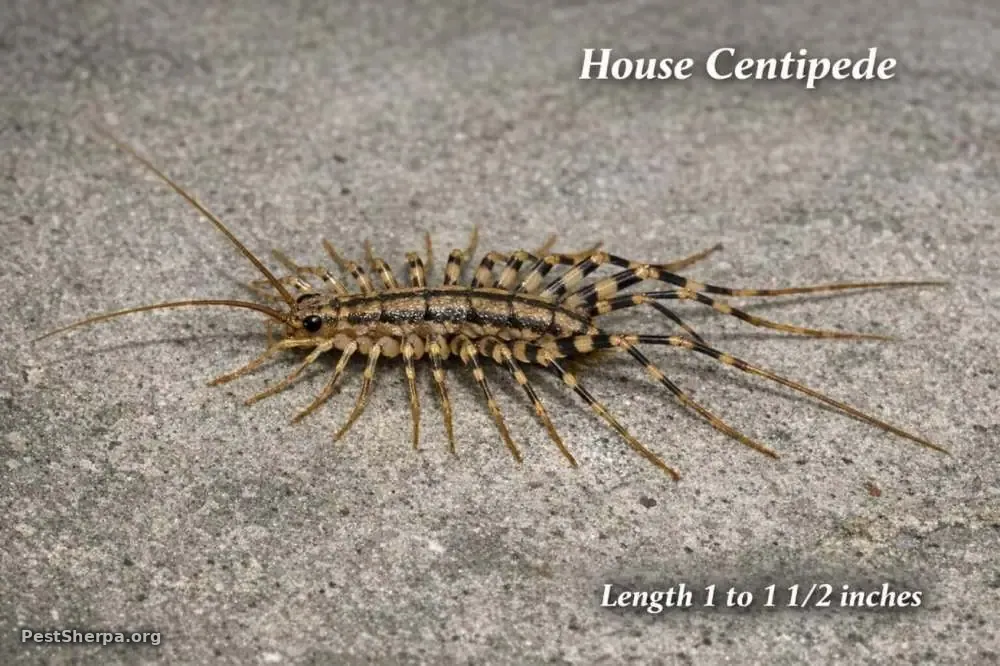
Centipedes are fast-moving arthropods in the class Chilopoda. They are not insects, and the name “centipede” can be misleading: it means “hundred feet,” but most centipedes do not have exactly 100 legs. What they do have is a long, segmented body with one pair of legs on most body segments, along with a pair of modified front appendages called forcipules that help them capture prey.
Outdoors, centipedes are usually beneficial predators. Indoors, they are more often a clue than a crisis. A centipede in a bathroom, basement, crawlspace, garage, or closet often points to moisture, gaps around the structure, or enough small insects and spiders to support hunting activity. This guide explains how to identify centipedes, what their presence may mean, where to inspect, what helps, what usually does not help, and when additional help may be worth considering.
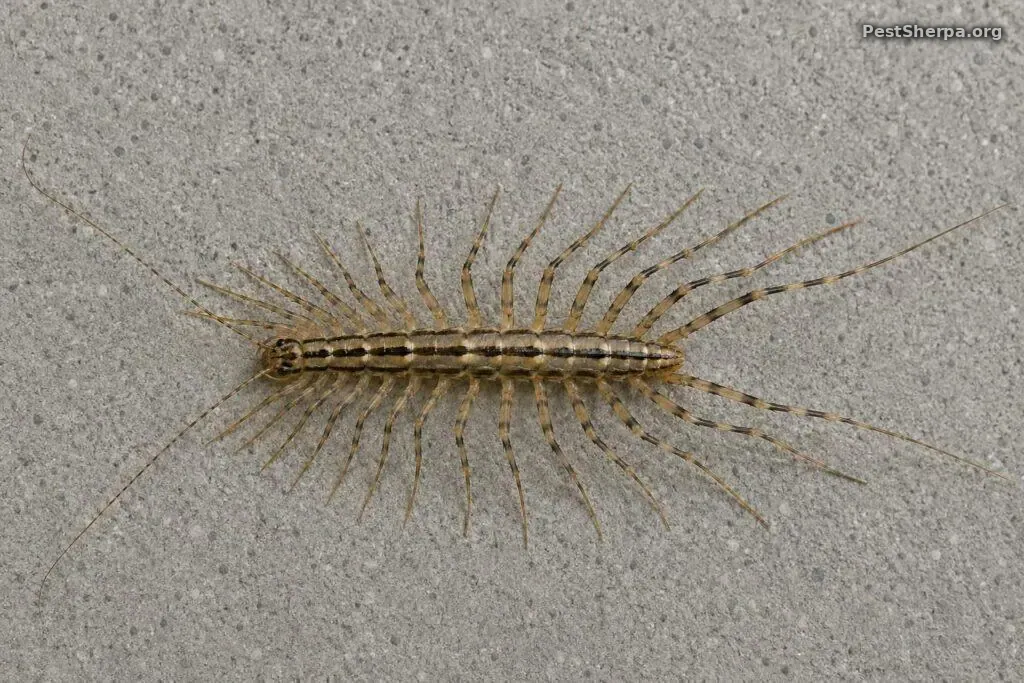
House centipede with long legs on concrete floor.
TL;DR
One centipede indoors usually does not mean an infestation. Centipedes are predators that feed on small arthropods such as insects and spiders. Frequent sightings, repeated activity in damp rooms, or centipedes found near sinks, basements, crawlspaces, or floor drains usually mean the area has moisture, shelter, entry gaps, or prey insects.
The best long-term approach is to reduce moisture, remove outdoor harborage near the foundation, seal entry points, vacuum visible centipedes, and investigate other pests that may be attracting them. Pesticides are not always necessary and should not be the first or only step.
Quick Navigation
- What Centipedes Mean Indoors
- Identification
- Centipede vs. Millipede
- Where Centipedes Show Up Indoors
- Source Investigation Checklist
- Why Centipedes Suddenly Appear
- Bites and Health Concerns
- What To Do
- What Does Not Work Well
- How Long Centipede Activity Lasts
- When Professional Help May Be Needed
- Lookalikes and Common Misidentifications
- FAQs
- References
What Centipedes Mean Indoors
Centipedes usually matter because of what they suggest about the environment. They need moisture, hiding places, and prey. Seeing one centipede may simply mean it wandered inside. Seeing them repeatedly can point to a damp basement, crawlspace moisture, cracks around the foundation, cluttered storage areas, or other small pests living nearby.
| What You See | What It May Mean | Best First Step |
|---|---|---|
| One centipede | Possible outdoor wanderer | Vacuum or capture and release outdoors |
| Several sightings in the same room | Moisture, shelter, or prey insects nearby | Inspect humidity, leaks, and clutter |
| Centipedes in basement or crawlspace | Damp conditions or exterior entry points | Improve drying and seal gaps |
| Centipedes plus silverfish, cockroaches, flies, or ants | Prey insects may be supporting activity | Identify and correct the underlying pest source |
| Centipedes after heavy rain or seasonal weather change | Outdoor moisture or shelter conditions may have shifted | Check foundation, door sweeps, mulch, and drainage |
Expert insight: Centipedes are often secondary invaders. Reducing the moisture and prey conditions that support them usually works better than repeatedly spraying the centipedes you happen to see.
Identification: What Centipedes Look Like
Centipedes are elongated arthropods with many body segments and one pair of legs on most segments. They are usually flattened from top to bottom and move quickly when disturbed. The common house centipede, Scutigera coleoptrata, is especially recognizable because it has a grayish-yellow body, dark body stripes or markings, very long legs, long antennae, and an overall “feathery-legged” appearance.
- Body shape: Long, narrow, and usually flattened.
- Leg pattern: One pair of legs on most body segments.
- Movement: Fast, sudden, and often alarming indoors.
- Antennae: Usually long and sensitive.
- Forcipules: Modified front appendages used to grasp and subdue prey.
- House centipede clue: Very long legs and a delicate, spider-like outline compared with many outdoor centipedes.
Centipedes are sometimes described as “hundred-leggers,” but leg number varies by group and life stage. Do not rely on counting legs for identification in a moving specimen. Body shape, speed, one-pair-per-segment leg arrangement, and indoor location are more useful clues.
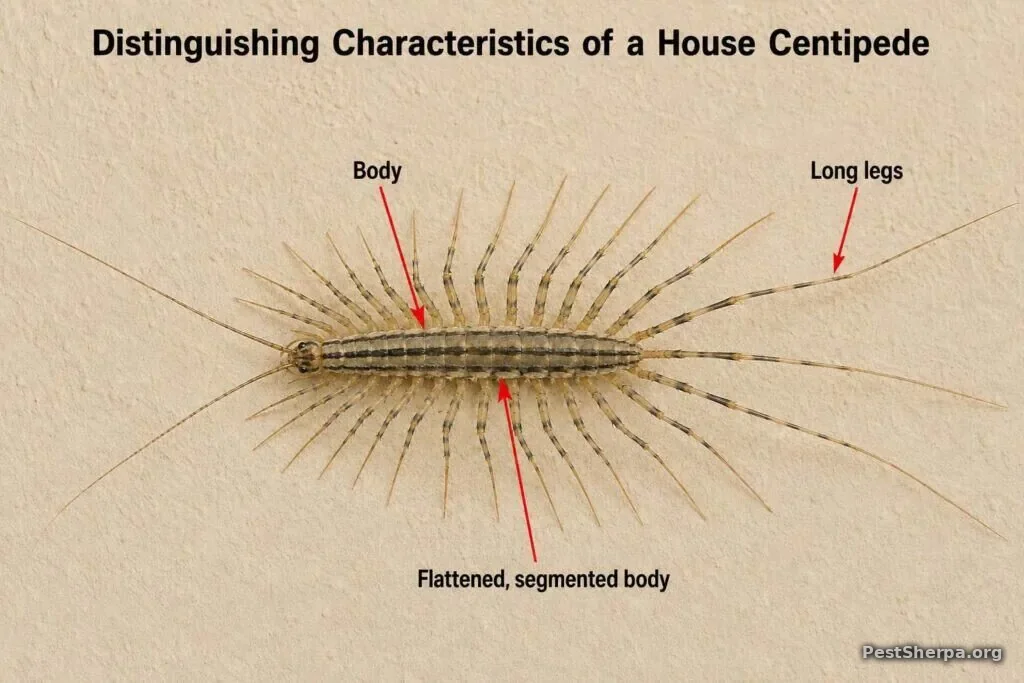
Labeled house centipede identification features.
Centipede vs. Millipede
Centipedes and millipedes are both many-legged arthropods, but they behave very differently. Centipedes are predators. Millipedes usually feed on decaying organic matter and are more likely to curl up when disturbed. If the animal is slow, rounded, and coils into a spiral, compare it with millipedes instead. See also: What is the difference between a house centipede and a millipede?
| Feature | Centipedes | Millipedes |
|---|---|---|
| Body shape | Usually flattened | Usually rounded or cylindrical |
| Legs per segment | One pair on most body segments | Two pairs on most visible body segments |
| Movement | Fast | Slow |
| Diet | Predators of small arthropods | Mostly decaying organic matter |
| Defensive behavior | Runs quickly; can bite if handled or trapped | Often curls up; does not bite |
| Indoor meaning | Moisture, shelter, or prey insects | Moisture, organic debris, or outdoor migration |
Where Centipedes Show Up Indoors
Centipedes prefer dark, protected, humid places. Indoors, they are most often noticed in areas that stay damp or have easy access to small prey insects.
- Basements
- Crawlspaces
- Bathrooms
- Laundry rooms
- Garages
- Closets and storage rooms
- Under sinks
- Near floor drains, sump areas, utility penetrations, and foundation cracks
Outdoors, centipedes shelter under rocks, wood, mulch, leaf litter, landscape fabric, stacked materials, and other objects that hold moisture. When those areas are directly against the foundation, centipedes and their prey are more likely to end up near entry points.
Centipede Source Investigation Checklist
Use this checklist to figure out why centipedes are showing up rather than only treating the ones you see.
Step 1: Check Moisture
- Look for plumbing leaks under sinks, around toilets, near water heaters, and in laundry areas.
- Check basement walls, crawlspace soil, sump areas, and floor drains for dampness.
- Use a dehumidifier where humidity stays high.
- Improve ventilation in crawlspaces, bathrooms, and laundry rooms where appropriate.
Step 2: Look for Prey Insects
Centipedes feed on small arthropods. Repeated sightings may be connected to other pest activity, including silverfish, cockroaches, ants, small flies, spiders, and other occasional invaders.
Step 3: Inspect Entry Points
- Foundation cracks
- Gaps under exterior doors
- Loose or damaged weatherstripping
- Openings around plumbing, utility lines, vents, and conduit
- Torn screens or gaps around basement windows
- Unsealed crawlspace or garage penetrations
Step 4: Check Outdoor Harborage
- Move firewood, lumber, stones, and stored materials away from the foundation.
- Thin heavy leaf litter and damp debris near exterior walls.
- Avoid excessive mulch depth directly against the structure.
- Correct drainage that keeps foundation edges wet.
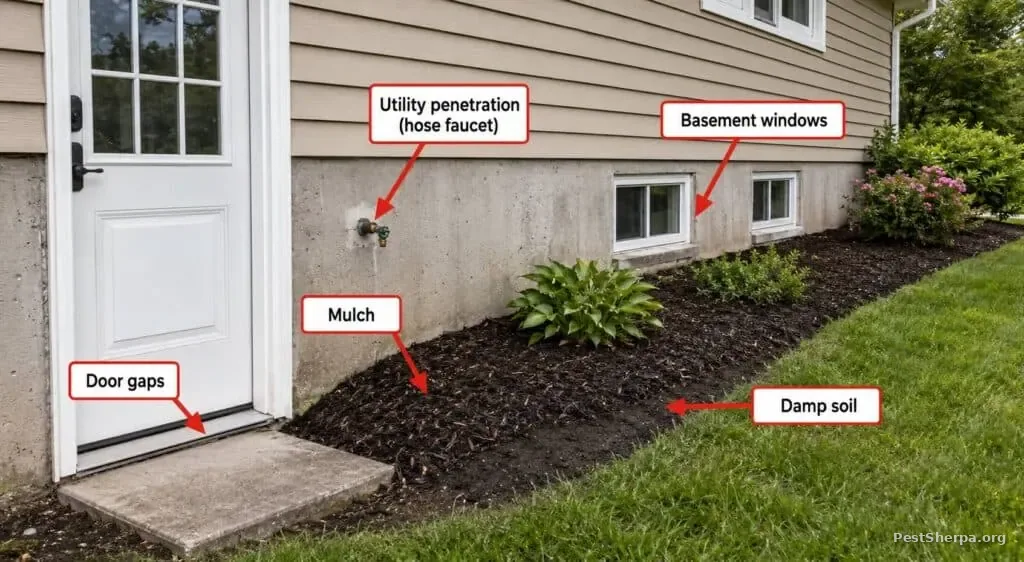
Common centipede entry points and moisture areas around a home.
Why Centipedes Suddenly Appear
A sudden centipede sighting does not always mean centipedes are breeding indoors. It often means conditions changed. Moisture, temperature, outdoor shelter, and prey insects can all shift quickly.
- Heavy rain: Saturated soil and exterior harborage may push centipedes toward drier shelter.
- Dry weather: Some centipedes may seek moisture in basements, bathrooms, or crawlspaces.
- Seasonal changes: Cooler or warmer weather can change where prey insects and centipedes move.
- Recent clutter movement: Moving boxes, wood, stored items, or mulch can disturb hiding places.
- Other pest activity: More silverfish, cockroaches, ants, flies, or spiders can make an area more attractive to hunting centipedes.
Life Cycle and Seasonal Context
Centipedes lay eggs in protected, humid locations. Young centipedes resemble smaller versions of adults, though leg number and body size vary as they grow. Most indoor concerns involve wandering or hunting adults rather than obvious nests that a homeowner can easily find.
Activity is usually more noticeable when moisture and prey are available. House centipedes can survive indoors where conditions stay favorable, especially in damp basements, crawlspaces, and other humid spaces. Other centipedes are more often outdoor animals that occasionally enter by accident.
Bites and Health Concerns
Centipedes are venomous predators, but they are not known as disease transmitters in homes. Bites are uncommon and usually happen when a centipede is handled, trapped against skin, stepped on, or caught in clothing or bedding. Smaller house centipedes are generally more alarming in appearance than medically important.
A bite from a larger centipede may cause localized pain, redness, or swelling, somewhat like a sting. People with unusual reactions, severe pain, spreading symptoms, signs of infection, or allergy concerns should contact a medical professional or poison control center for advice.
Safety note: Do not handle centipedes with bare hands. Use a cup and stiff paper, a vacuum, or gloves if removal is needed.
What To Do About Centipedes
1. Remove the Centipedes You See
Vacuuming is often the simplest indoor response. Empty the vacuum canister or bag outdoors if you are concerned about live arthropods. A cup-and-paper method can also work if you prefer to release the centipede outside.
2. Dry the Area
Fix leaks, run bathroom fans, improve crawlspace or basement drying, and use a dehumidifier where humidity remains high. Moisture reduction is one of the most important centipede prevention steps because it affects centipedes and many of the pests they eat.
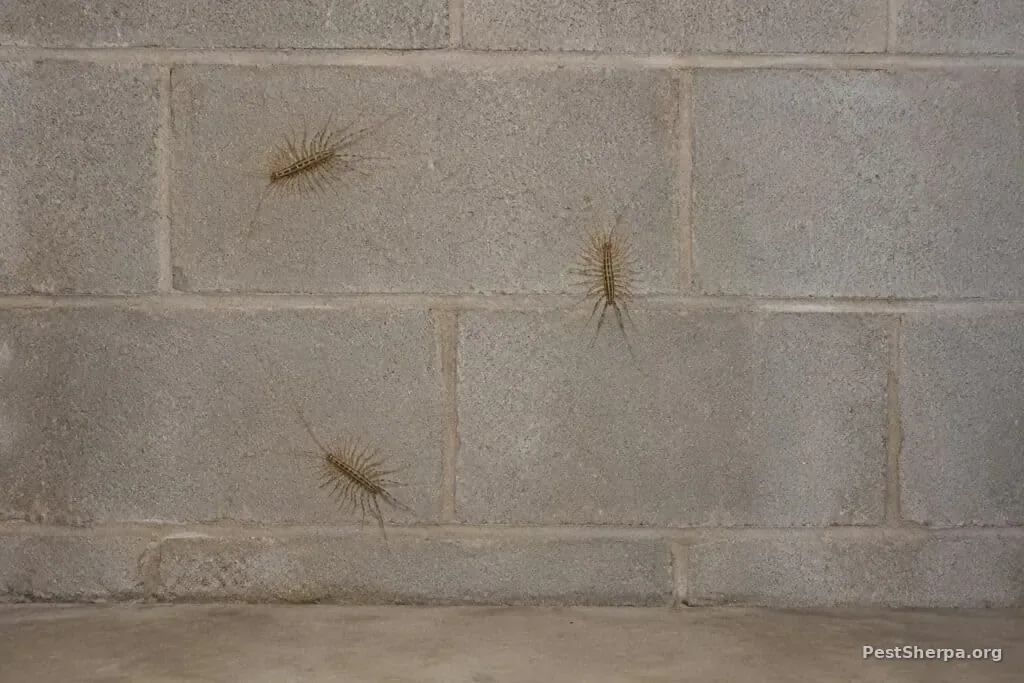
Centipedes on moist wall in basement; dehumidification will greatly reduce activity.

After dehumidification and reducing any water entry points, insects and centipedes will find the area less hospitable.
3. Reduce Harborage Indoors
Reduce clutter in basements, closets, garages, and storage rooms. Store items in sealed containers rather than damp cardboard where practical. Vacuum along baseboards, corners, under storage shelving, and behind appliances where small arthropods may hide.
4. Seal Entry Points
Install door sweeps, repair weatherstripping, seal foundation cracks where appropriate, repair screens, and close gaps around plumbing and utility penetrations. Exclusion is especially useful when centipedes are entering from damp outdoor harborage near the foundation.
5. Address Prey Pests
If centipedes appear along with other pests, identify those pests and correct their sources. For example, moisture-loving pests such as silverfish and firebrats may point to humidity problems, while cockroaches or ants may require separate source and sanitation investigation. A general fly identification guide, cockroach guide, or ant guide may help if the centipedes are not the only arthropods present.
6. Use Pesticides Carefully, If Needed
Pesticides are not always necessary for centipedes. When they are used, they work best as part of a broader moisture, exclusion, and prey-reduction plan. Always read and follow the product label. Keep children, pets, food, dishes, drains, and ventilation concerns in mind. Do not apply products into drains, vents, food-preparation areas, bedding, or other sensitive sites unless the label specifically allows that use.
What Does Not Work Well
- Only spraying visible centipedes: This does not correct moisture, entry points, or prey insects.
- Ignoring humidity: Damp basements, crawlspaces, and bathrooms can continue attracting centipedes and other arthropods.
- Leaving mulch and wet debris against the foundation: These areas can shelter centipedes and the insects they hunt.
- Using bug bombs or foggers as a first step: These products may not reach hidden harborage and can create unnecessary exposure risks if misused.
- Assuming every sighting means an infestation: A single centipede may be a wanderer, especially after weather changes.
How Long Will Centipede Activity Last?
The answer depends on why the centipedes are there. A single outdoor wanderer may be a one-time event. Repeated sightings can continue until moisture, prey, and entry conditions are corrected.
| Situation | Expected Pattern | What Helps Most |
|---|---|---|
| One accidental entry | No ongoing activity after removal | Remove the centipede and monitor |
| Damp basement or crawlspace | Repeated sightings may continue | Drying, ventilation, dehumidification, and sealing |
| Outdoor harborage against foundation | Seasonal or weather-related activity | Move debris, manage mulch, correct drainage |
| Prey insects indoors | Centipedes may continue hunting indoors | Identify and address the prey pest source |
| House centipedes established indoors | Ongoing but often low-level sightings | Moisture reduction, exclusion, cleaning, and monitoring |
When Professional Help May Be Needed
Many centipede problems can be improved with drying, exclusion, vacuuming, and outdoor habitat adjustments. Professional help may be worth considering when the underlying source is hard to find or when centipedes are part of a broader pest or moisture issue.
- Centipedes appear repeatedly in multiple rooms.
- There is ongoing basement, crawlspace, or wall moisture.
- You also see cockroaches, silverfish, ants, flies, or other pests.
- Activity continues after reasonable moisture and exclusion steps.
- You need help identifying whether the pest is a centipede, millipede, firebrat, silverfish, or another lookalike.
- A pesticide application is being considered in a home with children, pets, food-handling areas, drains, or other sensitive conditions.
Lookalikes and Common Misidentifications
Centipedes are often confused with other long-bodied or many-legged pests. Correct identification matters because the source conditions and next steps can differ.
| Lookalike | How It Differs | Why It Matters |
|---|---|---|
| Millipede | Slower, more rounded, often curls up, two pairs of legs on most visible body segments | Often tied to damp organic matter and outdoor migration |
| Silverfish | Small, wingless, carrot-shaped body with three tail-like filaments | Often tied to humidity, paper, starches, and hidden indoor harborage |
| Firebrat | Similar to silverfish but often associated with warmer areas | May point to warm, humid interior spaces |
| Sowbug or pillbug | Oval, armored body; pillbugs roll into a ball | Usually points to damp conditions and decaying organic matter |
| Camel cricket | Humpbacked body, enlarged jumping legs, no many-segmented centipede body | Often appears in damp basements, garages, and crawlspaces |
| Spiders | Eight legs, two main body regions, no many body segments | May indicate general prey availability but requires different identification |
FAQs About Centipedes
Does one centipede mean I have an infestation?
No. One centipede may simply have wandered indoors. Repeated sightings, especially in damp areas, are more useful evidence that indoor conditions are favorable.
Are centipedes dangerous?
Most indoor centipede encounters are nuisance concerns rather than serious health threats. Centipedes can bite if handled or trapped against skin, and larger species can cause localized pain or swelling. They are not known to spread diseases in homes.
Why are centipedes in my bathroom?
Bathrooms can provide humidity, water, darkness, and access to small insects. Check for leaks, condensation, gaps around plumbing, and poor ventilation.
Why are centipedes in my basement?
Basements often stay cooler, darker, and more humid than the rest of the home. Inspect foundation cracks, sump areas, floor-wall joints, stored cardboard, and other pests that may be serving as prey.
Do centipedes come up through drains?
Centipedes may be found near drains because those areas are humid and may have entry gaps nearby. Do not assume the drain itself is the source. Inspect plumbing penetrations, floor-wall gaps, nearby moisture, and surrounding rooms.
Should I kill house centipedes?
That is a personal comfort decision. House centipedes can eat other household pests, but many people do not want them indoors. Vacuuming, capture-and-release, drying, and exclusion are practical first steps.
Will centipedes go away if I use a dehumidifier?
A dehumidifier can help if moisture is part of the problem, but it works best with leak repair, ventilation, clutter reduction, exclusion, and control of prey insects.
What attracts centipedes?
Centipedes are attracted to moisture, shelter, and prey. Damp basements, crawlspaces, mulch near foundations, leaf litter, loose door seals, and other pest activity can all contribute.
References
- Utah State University Extension: Centipedes
- Penn State Extension: House Centipedes
- University of California Statewide IPM Program: Centipedes and Millipedes
- University of Missouri Extension: Millipedes and Centipedes
- University of Arizona Cooperative Extension: Centipedes
- Ohio State University Extension Ohioline: Centipedes
This article was written by Greg Baumann, founder of Pest Sherpa, and reflects more than 40 years of professional pest management experience.
About the Author

Greg Baumann | Pest Control Expert
Greg Baumann is the founder of Pest Sherpa and a Pest Control Expert with more than 40 years of professional pest management experience. His articles combine decades of field experience, technical expertise, and science-based guidance to help homeowners identify pests correctly, understand real-world risks, and make informed pest management decisions.
Mission: Identify the pest. Understand the risk. Stop the problem. Prevent the comeback. Know when it’s time to call a professional.